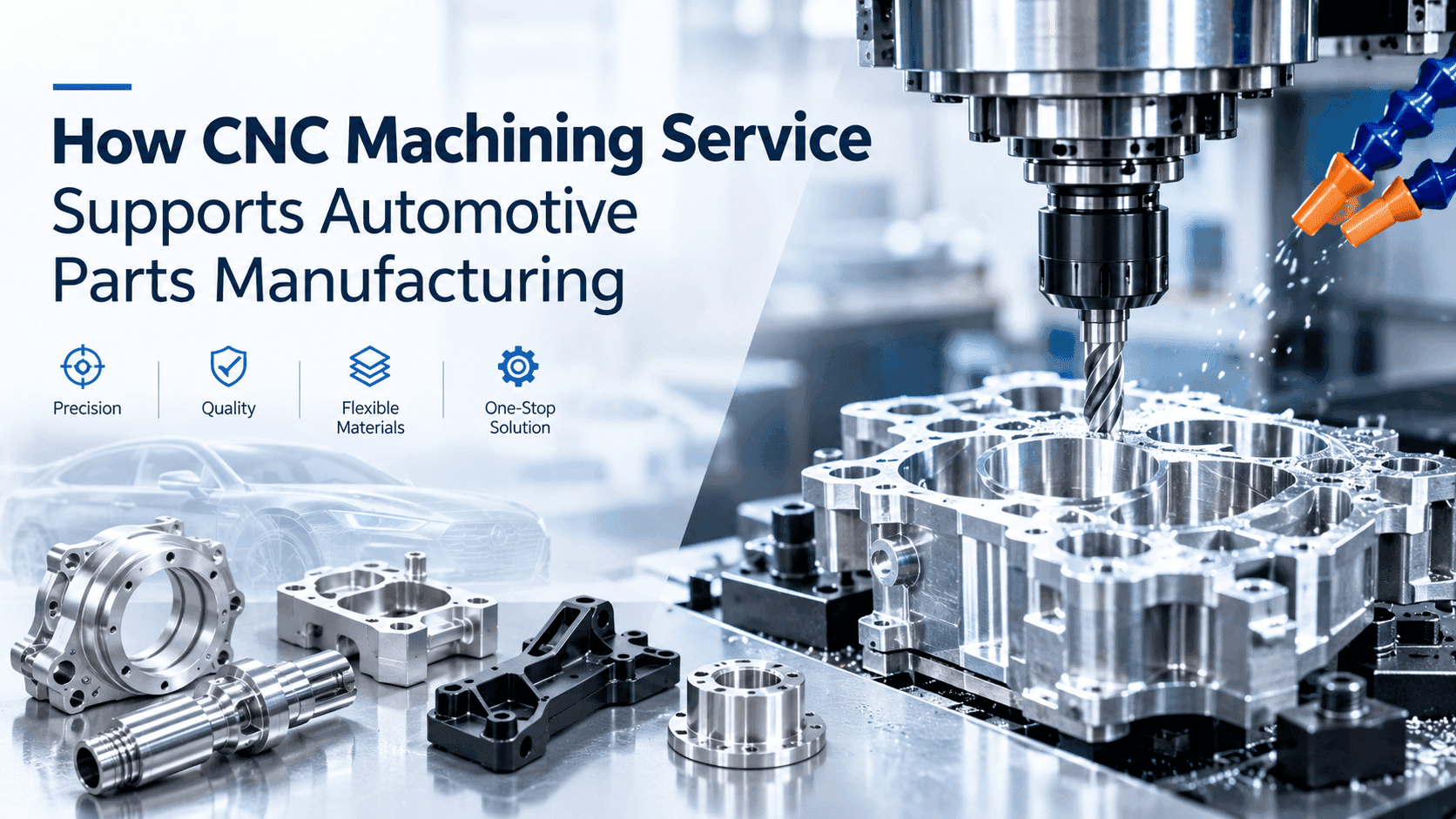
The automotive industry is changing quickly. Vehicles are becoming lighter, more electrified, and more dependent on precision mechanical and electronic components. At the same time, automotive manufacturers need to develop new parts faster and produce them with consistent quality.
This puts more pressure on the manufacturing process.
CNC machining is one of the manufacturing technologies that helps automotive companies meet these requirements. From prototypes and custom components to repeat production, CNC machining can produce complex metal and plastic parts with controlled dimensions and repeatable results.
For automotive manufacturers and suppliers, however, choosing CNC is not simply about putting a drawing into a machine. Material selection, machining strategy, tolerances, surface finishing, inspection, and production volume all affect the final result.
Automotive components often contain holes, pockets, threads, curved surfaces, mating features, and other details that must work together during assembly. A small dimensional variation in a critical feature can affect how another component fits or operates.
CNC machining uses computer-controlled toolpaths to remove material according to the part design. Once the machining process has been developed and verified, the same process can be repeated across a production batch.
This repeatability is one of the main reasons CNC machining is widely used for automotive components. Industry references commonly identify precision, consistency, flexibility, material versatility, and complex geometry as key advantages of CNC machining in automotive manufacturing.
Another important advantage is design flexibility. Engineers can modify a CNC program when they change a hole position, wall thickness, pocket geometry, or other feature. This makes CNC particularly useful during product development, where several design iterations may be required before a component reaches its final form.
CNC machining is not limited to one type of automotive component. The process can be used for a wide range of structural, mechanical, thermal, and electronic parts.
Brackets are among the most common CNC-machined automotive parts.
They may be used to mount sensors, motors, electrical components, suspension-related assemblies, or other equipment. Aluminum is often selected when weight reduction and machinability are important.
Shafts, Bushings and Cylindrical Components
CNC turning is particularly suitable for cylindrical parts such as:
For these components, controlling diameter, concentricity, threads, and surface finish can be more important than simply achieving the overall part size.
CNC milling can produce housings with pockets, mounting holes, internal cavities, and complex external profiles.
These parts are increasingly relevant in electric vehicles, where housings and enclosures are used around motors, sensors, power electronics, and other systems.
CNC machining is also used for various engine and transmission-related components. Published automotive machining references list components such as cylinder heads, shafts, gear-related components, housings, valves, and other precision mechanical parts among CNC applications.
The exact manufacturing process depends on the component's material, geometry, quantity, and tolerance requirements.
The growth of electric vehicles is creating new opportunities for precision machining.
Battery-related equipment, motor components, cooling systems, sensor housings, connectors, brackets, and power-electronics enclosures can all require CNC machining during development and production.
CNC is particularly useful when EV manufacturers need to make design changes quickly or produce relatively small batches of new components before production volumes increase.
Different automotive components require different machining strategies.
CNC milling is suitable for parts with flat surfaces, pockets, slots, holes, contours, and three-dimensional features.
CNC turning is better suited to rotational parts where the main geometry is cylindrical.
For more complicated components, 4-axis and 5-axis machining can provide access to multiple surfaces with fewer setups. This can be useful for components with angled holes, curved surfaces, deep pockets, or complex three-dimensional geometry.
Modern automotive machining equipment commonly includes vertical machining centers, turning centers, multitasking lathes, and 5-axis machines.
But there is an important engineering point:
More machine axes do not automatically mean a better manufacturing solution.
A simple bracket may be produced efficiently on a 3-axis machine. A complicated housing may benefit from 4-axis or 5-axis machining. The right solution depends on the geometry, tolerances, quantity, and required cycle time.
At LongWang, our CNC machining capability includes 3-axis, 4-axis, and 5-axis CNC machining and CNC turning, allowing the machining method to be matched to the actual part requirements rather than forcing every component into the same process.
Material selection is closely connected to the function of an automotive component.
Aluminum alloys are widely used when manufacturers need a combination of low weight, strength, corrosion resistance, and good machinability.
Common applications include:
Stainless steel is suitable for components that require corrosion resistance and mechanical durability.
Depending on the application, different grades may be selected according to strength, corrosion resistance, machinability, and operating conditions.
Steel remains important for components exposed to higher loads, wear, or mechanical stress.
CNC turning and milling can be used to produce shafts, bushings, fixtures, brackets, and other precision mechanical components.
Automotive components do not always have to be metal.
Materials such as POM, Nylon, and PEEK can be used for selected bushings, spacers, insulating components, and other applications where low weight, electrical insulation, wear resistance, or chemical resistance is required.
The key is to select the material based on the actual application rather than simply choosing the material that is easiest to machine.
Automotive parts need to fit together consistently. For this reason, precision machining is only one part of the quality equation.
A reliable manufacturing process starts with the engineering drawing.
Before machining, engineers should review:
Not every dimension needs an extremely tight tolerance.
For example, a cosmetic outer dimension and a bearing bore may have completely different functional requirements. Applying unnecessarily tight tolerances to every feature can increase machining time and cost without improving the performance of the finished component.
For critical automotive components, CNC machining references commonly discuss tolerances around ±0.01 mm for selected features, although the achievable result depends on the machine, material, geometry, tooling, temperature, fixturing, and inspection method.
This is why experienced engineering support matters.
At LongWang, quality control is supported by an established quality management system, including ISO 9001, ISO 14001, and IATF 16949. For automotive-related projects, inspection and process requirements can be reviewed according to the customer's drawings and quality specifications.
Machining does not always end when the cutting tool leaves the part.
Depending on the application, CNC-machined automotive components may require additional processes such as:
For example, anodizing can be used on aluminum components when improved surface protection and appearance are required. Heat treatment may be selected for certain steel components where increased hardness or mechanical performance is important.
Surface finish should also be considered together with dimensional requirements.
A bearing seat, sealing surface, sliding area, and cosmetic exterior do not necessarily need the same surface roughness.
This is one reason why it is useful to work with a manufacturer that can coordinate machining and secondary processes rather than treating each operation as a completely separate project.
Price is important, but it should not be the only factor when selecting a CNC supplier. Before placing an automotive machining project, consider six areas:
A supplier that can answer these questions clearly is usually easier to work with over the entire product lifecycle.
For automotive customers, the machining process is only part of the supply chain.
A typical custom component may require:
Design Review → Material Sourcing → CNC Machining → Deburring → Surface Treatment → Inspection → Assembly → Packaging → Delivery
Managing these steps through multiple suppliers can create additional communication and quality-control work.
A one-stop manufacturing partner can simplify the process by coordinating multiple operations under one production system.
This is where LongWang's manufacturing model is designed to add value.
Based in Dongguan, Guangdong, China, Longwang provides integrated precision metal manufacturing services covering design support, CNC machining, CNC turning, sheet metal fabrication, surface finishing, assembly, supply chain management, and logistics support.
Our production operation covers nearly 30,000 m², with 500+ employees and 700+ machines, supporting projects ranging from prototype components to repeat production.
Automotive components often sit at the intersection of precision, reliability, cost, and delivery. Longwang combines CNC machining with engineering support, sheet metal fabrication, surface treatment, assembly, and supply chain capabilities to provide a more complete manufacturing solution.
Our CNC capabilities include 3-axis, 4-axis, 5-axis machining and CNC turning, allowing different automotive components to be matched with appropriate machining strategies.
With more than 20 years of industry experience, a large-scale manufacturing facility, and a broad range of production equipment, LongWang supports customers from initial design review through finished-part delivery.
Whether you need a few functional prototypes, custom automotive components, or repeat production parts, our engineering team can review your drawings and recommend a practical manufacturing approach.
Need Custom Automotive Parts?
Send us your 2D drawings or 3D CAD files. Our engineering team can review the part structure, material, tolerances, machining process, surface finish, and production requirements before quotation.
Next
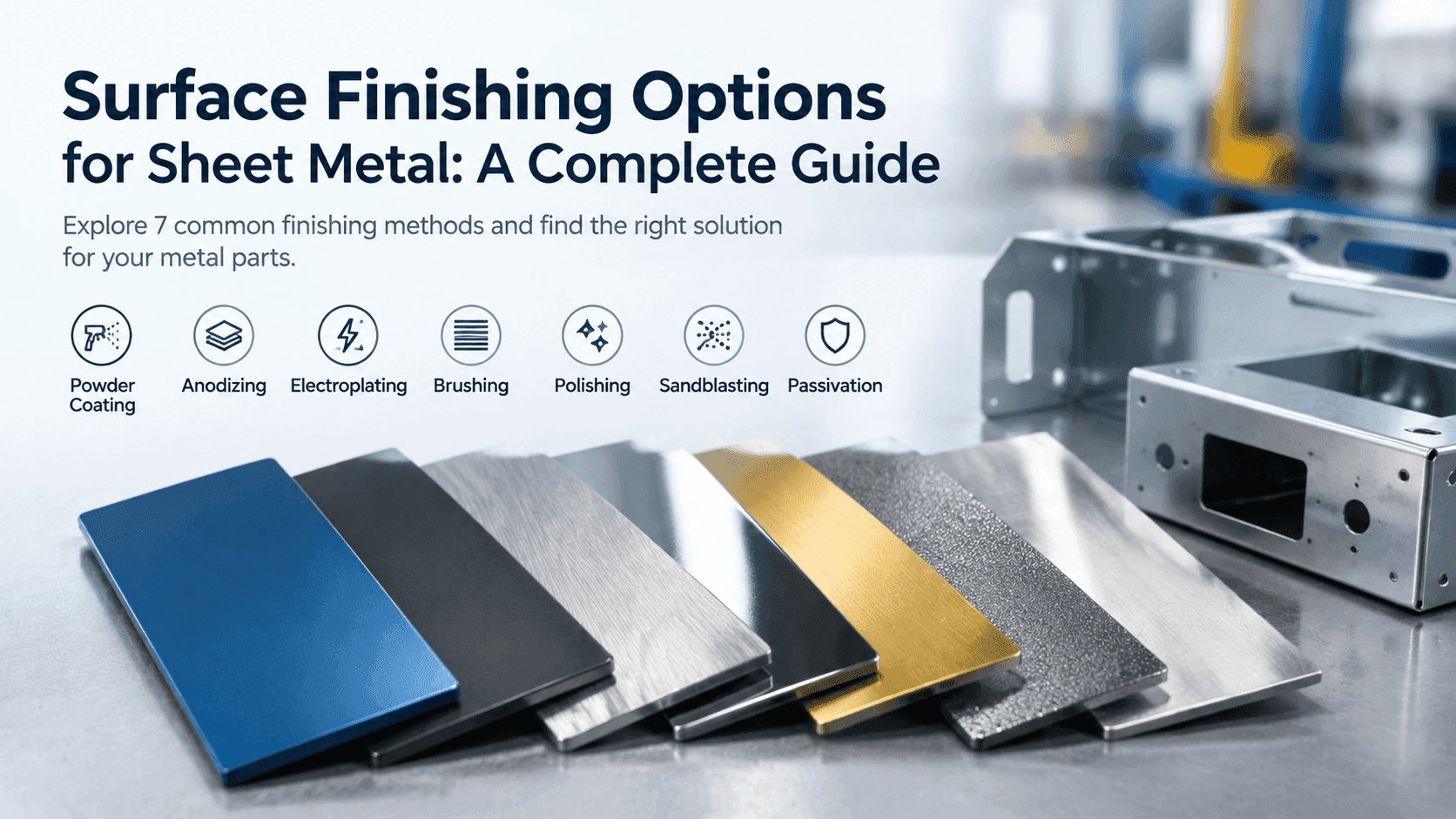
7 Surface Finishing Options for Sheet Metal: A Complete Guide
2026-09-16Explore 7 sheet metal finishing options, including powder coating, anodizing, electroplating, brushing, polishing, sandblasting, and passivation, to choose the right finish for your metal parts.
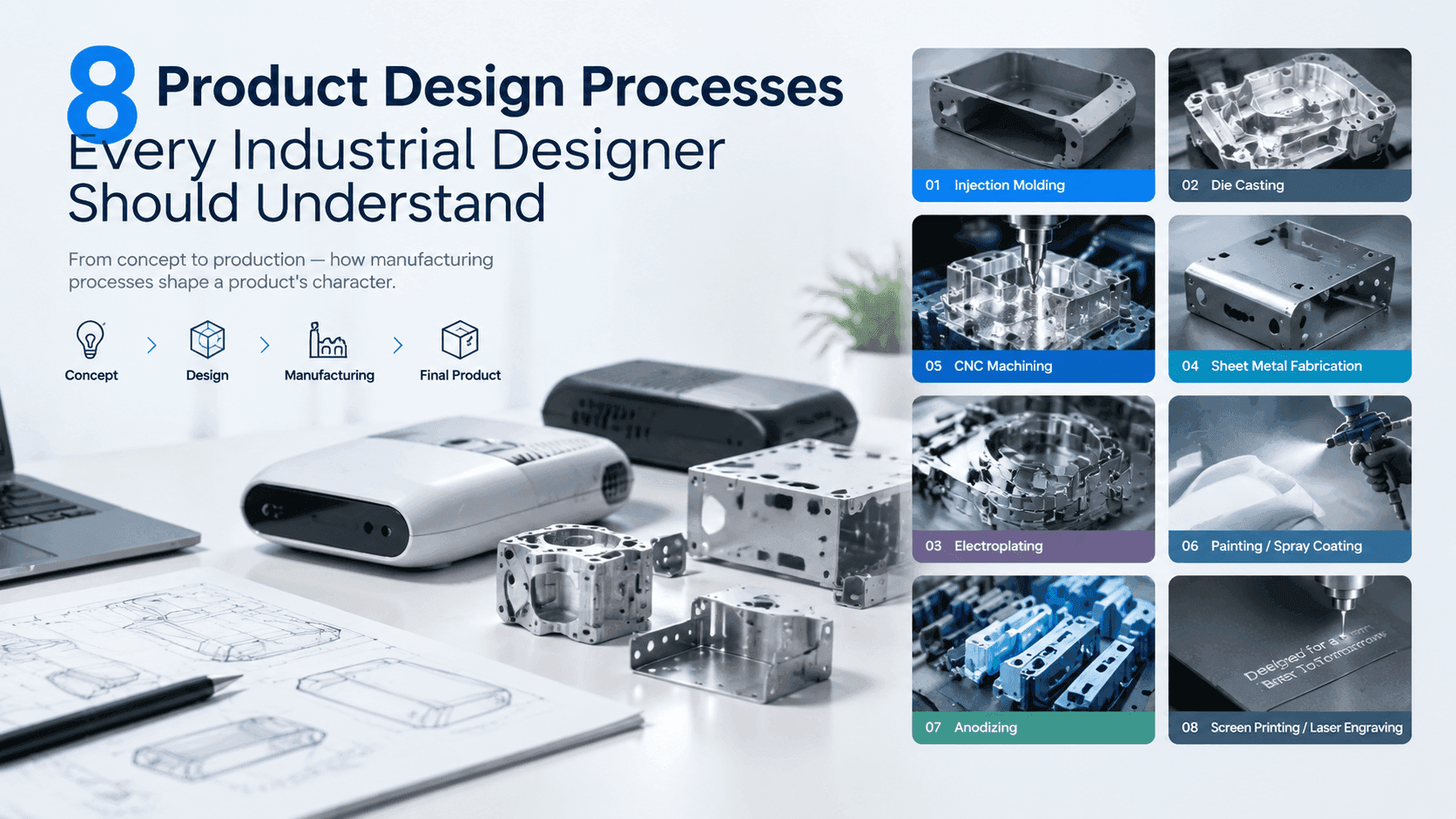
8 Product Design Processes Every Industrial Designer Should Understand
2026-09-15When designing a product, it is easy to focus only on the form and renderings. The final concept may look great, but when someone asks how it will actually be manufactured, the answer may not be so clear.

Get in Touch With us
Helping customers grow steadily and achieve win-win development

Your trusted partner for CNC machining, sheet metal fabrication, stamping, and assembly. From prototyping to mass production with strict quality control.
tel:
0769-82763299
Mobile:
+86 18988716988
fax:
0769-82763199
Address:
No.3 Longze Road, Chang'an Town, Dongguan City, Guangdong Province, China,523861


Copyright © 2008-2026 | Dongguan Longwang Hardware Co., Ltd. | All Rights Reserved.


