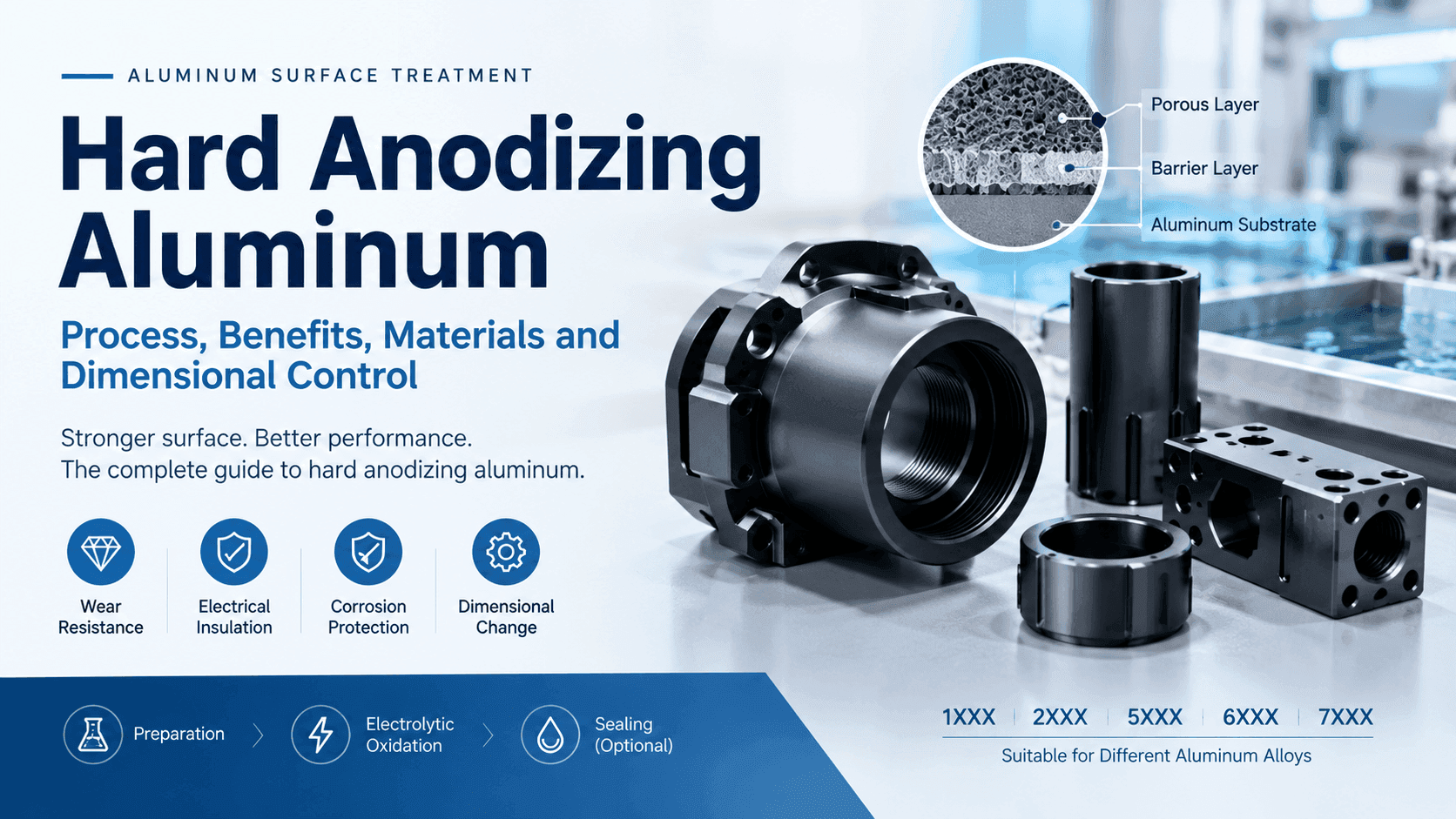
Hard anodizing, also called hardcoat anodizing, is a specialized aluminum surface treatment used when a component needs better wear resistance, hardness, electrical insulation, and corrosion protection. Compared with conventional anodizing, hard anodizing produces a much thicker and harder oxide layer, making it suitable for functional components rather than purely decorative applications.
For CNC machined aluminum parts, however, hard anodizing is more than a finishing process. The coating changes the surface dimensions of the part, so material selection, machining tolerances, and finishing requirements should be considered before production.
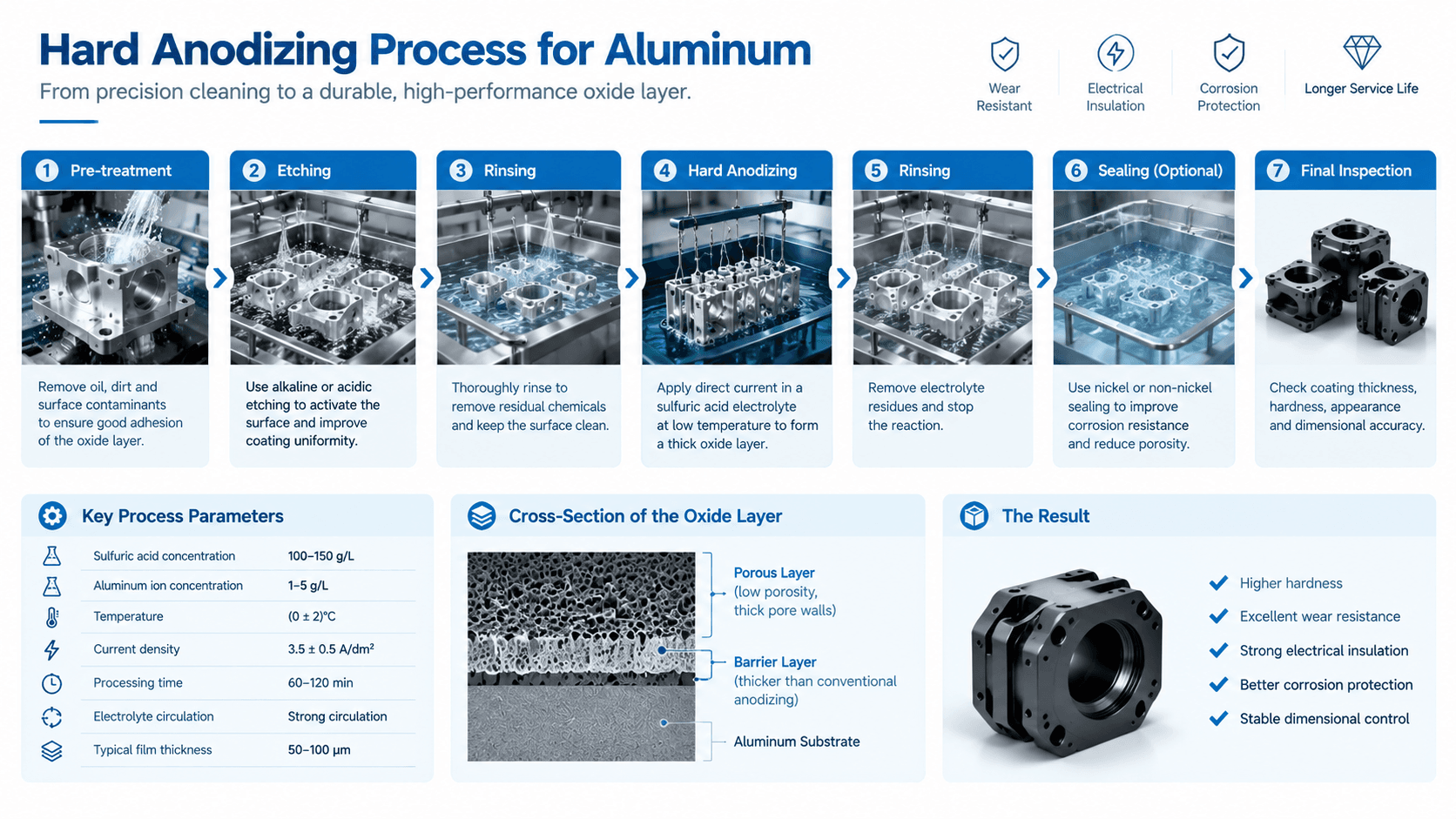
Hard anodizing is an electrochemical process that converts the surface of aluminum into a durable aluminum oxide layer. The aluminum component acts as the anode and is immersed in an acidic electrolyte while direct current is applied.
The resulting oxide film has a porous structure, but compared with conventional anodizing, the hardcoat has thicker pore walls, lower porosity, and a significantly thicker barrier layer.
Typical hard anodizing can produce coating thicknesses from approximately 25-250μm, depending on the alloy and process conditions. Hardness can reach around HV500, while the exact performance depends on the aluminum alloy and processing parameters.
Unlike decorative anodizing, which is often selected for appearance and color, hard anodizing is primarily used for functional performance such as wear resistance and electrical insulation.
The two processes use similar electrochemical principles, but their operating conditions and resulting film properties are different.
| Property | Conventional Anodizing | Hard Anodizing |
|---|---|---|
| Typical film thickness | 5-20μm | 300-250μm |
| Microhardness | 100-300 HV | 300-600 HV |
| Porosity | 20-30% | 2-6% |
| Surface appearance | Relatively smooth | Usually rougher |
| Electrical resistance | Lower | Higher |
| Main purpose | Decorative & protective | Functional & wear-resistant |
Hard anodizing generally uses lower bath temperatures, lower sulfuric acid concentrations, and higher current densities than conventional anodizing. The source material describes hard anodizing temperatures around 0℃, with strong electrolyte circulation required to maintain stable processing conditions.
A typical sulfuric-acid hard anodizing process includes several important parameters:
Adjust the actual parameters based on the aluminum alloy, required coating thickness, dimensional tolerances, and target performance.
Because hard anodizing generates considerable heat during processing, temperature control and electrolyte circulation are especially important. Lower processing temperatures generally help produce harder oxide films.
Hard anodizing significantly improves the surface hardness and wear resistance of aluminum parts. This makes it suitable for sliding, rotating, and frequently contacted parts where surface durability is important.
The source indicated that hard anodized aluminum can provide approximately 1-2 times the wear resistance of conventional anodized aluminum in many alloys.
Anodized aluminum oxide is electrically non-conductive. Hard anodized films can provide high electrical resistance, with breakdown voltage potentially reaching more than 1000V depending on the coating and process.
This makes hard anodizing useful for selected components requiring both lightweight construction and electrical insulation.
The thicker oxide layer generally provides stronger corrosion resistance than conventional anodizing. For applications requiring additional protection, sealing or other post-treatment methods can further improve corrosion performance.
However, hard anodized films may contain microcracks, particularly at greater thicknesses, so the treatment should be selected according to the actual service environment.
Aluminum combines low weight with good machinability. Hard anodizing can further improve its surface performance, allowing some components traditionally made from stainless steel or treated with hard chrome to be produced from aluminum instead.
Not every aluminum alloy responds to hard anodizing in the same way.
1XXX series: Generally easy to hard anodize and capable of producing high hardness, highly insulating films.
2XXX series: More difficult because copper-rich intermetallic compounds can interfere with oxide formation and cause defects such as pinholes.
5XXX series: Can be hard anodized, although hardness may be somewhat lower than comparable 6XXX alloys.
6XXX series: Generally suitable for producing high quality hard anodized films and commonly used for functional aluminum components.
7XXX series: More challenging to process and may show pinholes or lower wear resistance compared with some other alloys.
For precision CNC machining, therefore, discuss alloy selection together with the required surface treatment rather than treating them as two separate decisions.
This is a common concern when assembling two aluminum parts or when different areas of the same part show visible color differences.
Hard anodizing does not automatically eliminate color variation. The final appearance of a hard anodized surface depends on factors including aluminum alloy, material lot, coating thickness, surface preparation, part geometry, current distribution, racking, and process conditions.
For example, up and down components may appear different if they are positioned differently in the anodizing tank or experience different current density and electrolyte flow. Different machining textures or surface roughness can also change how the finished surface reflects light.
Hard anodizing can improve consistency when the process is tightly controlled, but it should not be treated as a guaranteed solution for color matching. For cosmetic assemblies, manufacturers should consider:
Undyed hardcoat can naturally range from gray to dark gray or bronze depending on the alloy and coating thickness. Therefore, color should not be used as the only indicator of coating thickness or quality.
If appearance matching is a critical requirement, it is important to define an acceptable color range and inspection method before production rather than simply specifying "black hard anodizing".
One of the most important considerations for precision machined aluminum parts is dimensional growth.
During hard anodizing, approximately half of the oxide layer grows into the aluminum substrate, while the other half builds outward from the original surface. As a result, external dimensions generally increase while internal holes become smaller.
For this reason, CNC machining dimensions should be calculated based on the expected final coating thickness. Parts that require post-anodizing assembly or further machining may also need appropriate machining allowance and dedicated fixturing areas.
For precision CNC machined aluminum parts, hard anodizing should be considered during the design stage. Material selection, coating thickness, dimensional tolerance, masking areas, surface roughness, and assembly requirements can all influence the final result.
At Longwang, we combine precision CNC machining with professional surface finishing to support customers from material selection and machining through final surface treatment. By considering the hard anodizing process during the engineering stage, we can help optimize part dimensions and finishing requirements before production.
If you are developing precision aluminum parts that require hard anodizing, high wear resistance, electrical insulation, color consistency, or dimensional control, share your drawings and specifications with our engineering team for a manufacturing assessment.
Next

Mid-Autumn Festival & National Day Holiday Notice 2026
2026-09-24Mid-Autumn Festival & National Day Holiday Notice 2026
How CNC Machining Supports Automotive Parts Manufacturing
2026-09-17Explore CNC machining applications, materials, precision, EV parts and production solutions for the automotive industry.

Get in Touch With us
Helping customers grow steadily and achieve win-win development

Your trusted partner for CNC machining, sheet metal fabrication, stamping, and assembly. From prototyping to mass production with strict quality control.
tel:
0769-82763299
Mobile:
+86 18988716988
fax:
0769-82763199
Address:
No.3 Longze Road, Chang'an Town, Dongguan City, Guangdong Province, China,523861


Copyright © 2008-2026 | Dongguan Longwang Hardware Co., Ltd. | All Rights Reserved.


