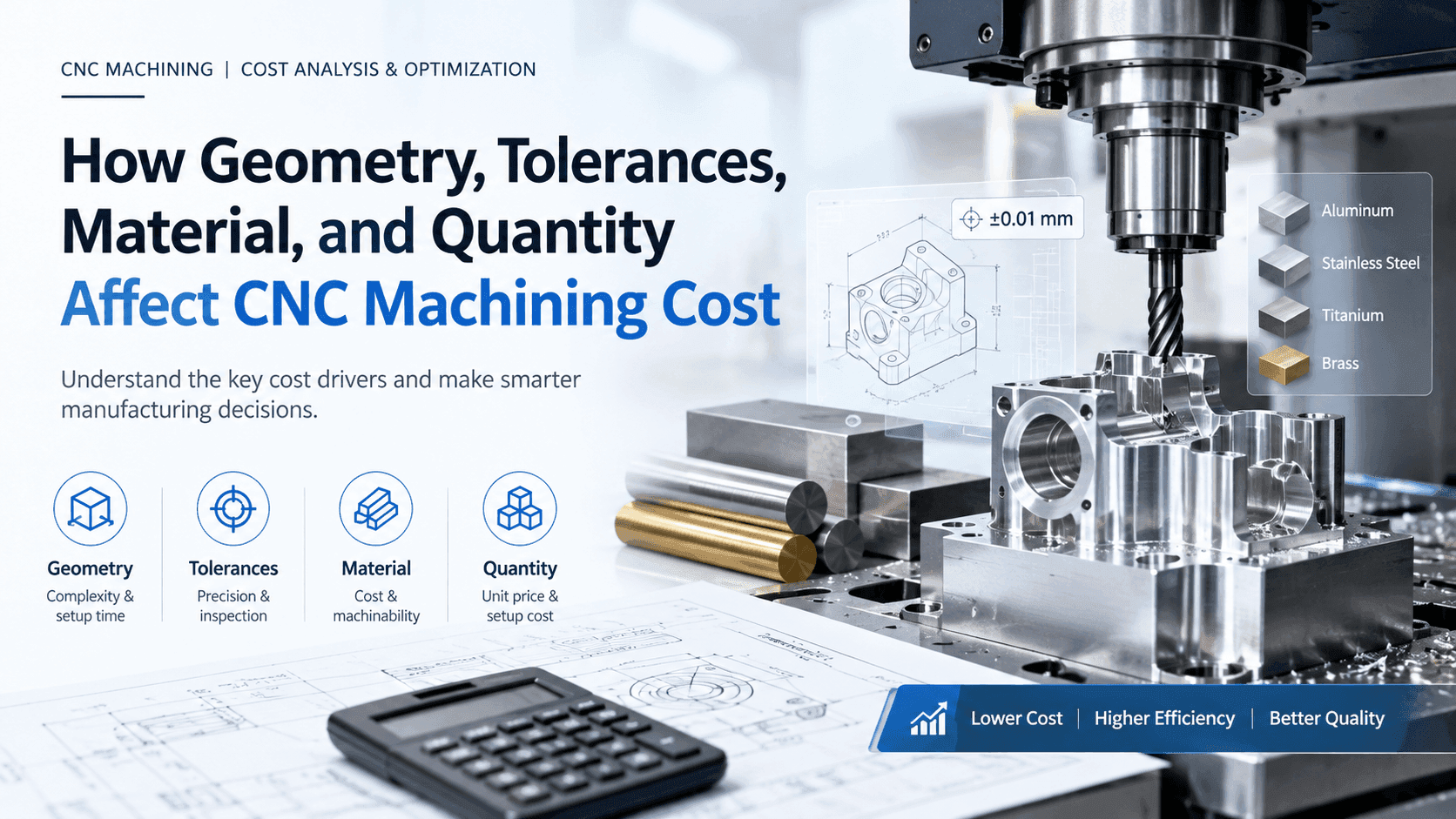
For product designers and purchasing teams, understanding these factors early can prevent unnecessary expenses without compromising part performance. A complex aluminum housing with loose tolerances may cost less than a simple stainless steel shaft that requires micron-level precision. Likewise, ordering 100pcs instead of one can significantly reduce the cost per unit.
This guide explains the main cost drivers, provides practical calculations, and shows how to optimize a CNC machining project for both quality and budget.
Geometry determines how easily a CNC machine can access and remove material. Simple shapes generally require fewer machining operations, while complex designs demand more programming, specialized tooling, and setup time.
Several geometric features have a direct impact on cost:
For example, a simple aluminum mounting bracket may be completed in one setup, while a housing with deep cavities and angled holes may require several operations on different faces.
Cost-saving tip: Simplify nonfunctional features, increase internal corner radii where possible, and design parts to minimize repositioning. A design that allows more features to be machined in one setup can reduce both labor and dimensional variation.
Tolerance specifies the acceptable variation from a nominal dimension. Tighter tolerances require greater control over tool wear, thermal expansion, machine accuracy, and inspection.
Consider a 20mm diameter shaft:
The second specification provides a much narrower acceptable range. Depending on the feature and material, it may require finishing passes, more frequent measurements, precision fixtures, or additional grinding.
There is no universal percentage increase for tighter tolerances. The additional cost depends on how many features are controlled, the required geometric accuracy, and the inspection method. A single precision bore is usually less expensive to manage than applying the same tight tolerance to every dimension.
For general CNC milling and turning, a practical reference range is approximately ±0.05 to ±0.10mm when the design, material, machine, and process are suitable. For some exterior parts without assembly functions, some suppliers also use ±0.125mm as a general tolerance baseline.
Precision features can often be machined to ±0.01-0.025mm, but achieving these values consistently requires process-specific verification. These ranges are indicative, not universal guarantees. Always confirm the supplier's standard tolerance policy and the requirements of your drawing.
In geometric dimensioning and tolerancing, geometric controls are commonly grouped into four categories:
These controls address different functional requirements. For instance, a shaft may need a tight diameter tolerance and a separate runout requirement to ensure smooth rotation. Correctly specifying both is more useful than tightening every dimension indiscriminately.
There is no single minimum tolerance for every CNC machining process. Specialized machining operations can achieve tolerances of a few micrometers under suitable conditions, while certain precision applications require even tighter control through grinding, lapping, or other finishing methods.
For reference, 0.005mm equals 5 micrometers. Holding this tolerance consistently across a production batch is substantially more demanding than achieving it on one prototype.
Material stability, feature geometry, machine capability, temperature, and measurement uncertainty all matter. Before specifying an ultra-tight tolerance, confirm that it is functionally necessary and achievable for the complete manufacturing process.
Material affects both direct purchasing expenses and the time required to produce a finished component.
Aluminum alloys such as 6061 are widely used because they offer a favorable balance of machinability, weight, and cost. Stainless steels such as 304 and 316 generally require more careful cutting conditions. Titanium alloy and nickel-based superalloys can demand specialized tooling and substantially longer machining cycles.
Material cost also depends on stock dimensions, availability, purchase quantity, and the amount of material removed.
For example, a component machined from a large billet may generate considerable scrap when its final geometry is small. Deep cavities and thin-wall designs can make this material waste especially significant.
Cost-saving tip: Select materials based on actual mechanical, thermal, corrosion, and regulatory requirements. Where the application permits, consider a more machinable alloy or redesign the part to reduce unnecessary stock removal. Do not substitute materials without verifying functional and safety requirements.
CNC machining includes both fixed and variable expenses.
Fixed expenses include CAD/CAM programming, fixture preparation, machine setup, and first piece inspection. Variable expenses include material consumption, machine cycle time, tooling wear, and per-part inspection.
Increasing the order quantity spreads fixed costs across more parts, usually reducing the unit price.
For example, assume a hypothetical job has:
The estimated unit cost is:
| Order quantity | Total estimated cost | Cost per part |
|---|---|---|
| 1 | $320 | $320 |
| 10 | $500 | $50 |
| 100 | $2,300 | $23 |
| 500 | $10,300 | $20.60 |
These figures are illustrative, not supplier quotations. They exclude any additional finishing, shipping, taxes, and inspection costs.
Larger orders can also justify dedicated fixtures or optimized toolpaths. However, higher quantities do not always produce proportionate savings, especially when material prices fluctuate, or every part requires extensive inspection.
A practical estimating model is:
Total cost= Material + Programming and setup + Machining +Tooling + Finishing + Inspection + Packaging
For a simple estimate, machining cost can be calculated as:
Machining cost = Machine hourly rate x Total machine hours
Suppose a batch of 100 aluminum parts requires 0.25 machine hours per part at $60 per machine hour.
Actual supplier pricing may also include overhead, scrap allowance, production risk, and profit margin. Therefore, the formula is a useful estimating framework rather than a complete commercial pricing model.
Machining time depends on the cutting path, material removal rate, tool selection, feed rate, spindle speed, and number of operations.
For a milling operation, a simplified estimate is:
Cutting time = Toolpath length ÷ Feed rate
If a tool travels 600mm at a feed rate of 1200mm/min, the theoretical cutting time is:
600 ÷ 1200 = 0.5 minutes
This calculation covers only the specified cutting movement. Actual cycle time must also account for tool changes, rapid movements, approach and retract distances, multiple passes, workpiece repositioning, and inspection.
For production planning, the estimated cycle time should be checked against CAM simulation and actual machine performance. Material hardness, tool wear, and part stability can all change the final result.
The most effective way to control CNC machining cost is to optimize the drawing before manufacturing begins.
Use tight tolerances only where assembly or performance requires them, choose materials according to real operating conditions, simplify difficult geometry, and provide realistic order quantities. These decisions can reduce machining time and inspection effort without sacrificing quality.
Planning a custom CNC machining project? Contact Longwang with your 2D drawings or 3D CAD files, material specifications, tolerance requirements, and estimated order quantity for a manufacturing review and quotation.
At Longwang, reviewing part drawings, material requirements, tolerances, and production quantities early helps identify potential manufacturing challenges before they become costly production issues. A well-planned CNC machining project starts with a design that balances precision, manufacturability, and total cost.
Next

Swiss CNC Machining Services for Medical Devices: A Complete Guide
2026-10-09Medical device components often look simple on a drawing, but producing them consistently can be challenging. A small shaft may require several diameters, a narrow groove, a cross-hole, and a precisely controlled surface finish. When these features must fit together reliably, the choice of machining process becomes important.
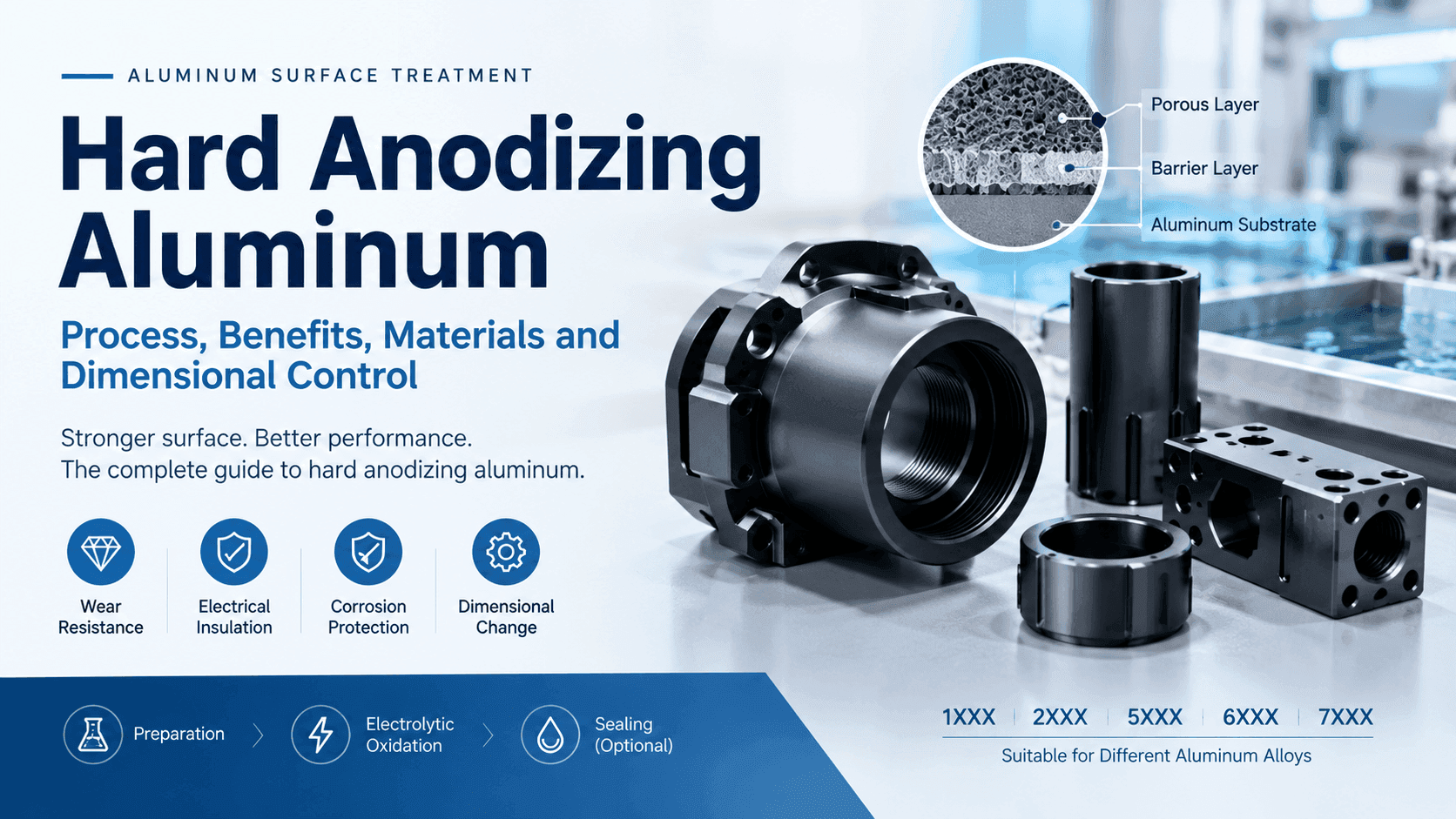
Hard Anodizing Aluminum: Process, Benefits, Materials and Dimensional Control
2026-09-27Hard anodizing improves the hardness, wear resistance, electrical insulation, and corrosion protection of aluminum parts while requiring careful dimensional control.

Get in Touch With us
Helping customers grow steadily and achieve win-win development

Your trusted partner for CNC machining, sheet metal fabrication, stamping, and assembly. From prototyping to mass production with strict quality control.
tel:
0769-82763299
Mobile:
+86 18988716988
fax:
0769-82763199
Address:
No.3 Longze Road, Chang'an Town, Dongguan City, Guangdong Province, China,523861


Copyright © 2008-2026 | Dongguan Longwang Hardware Co., Ltd. | All Rights Reserved.


