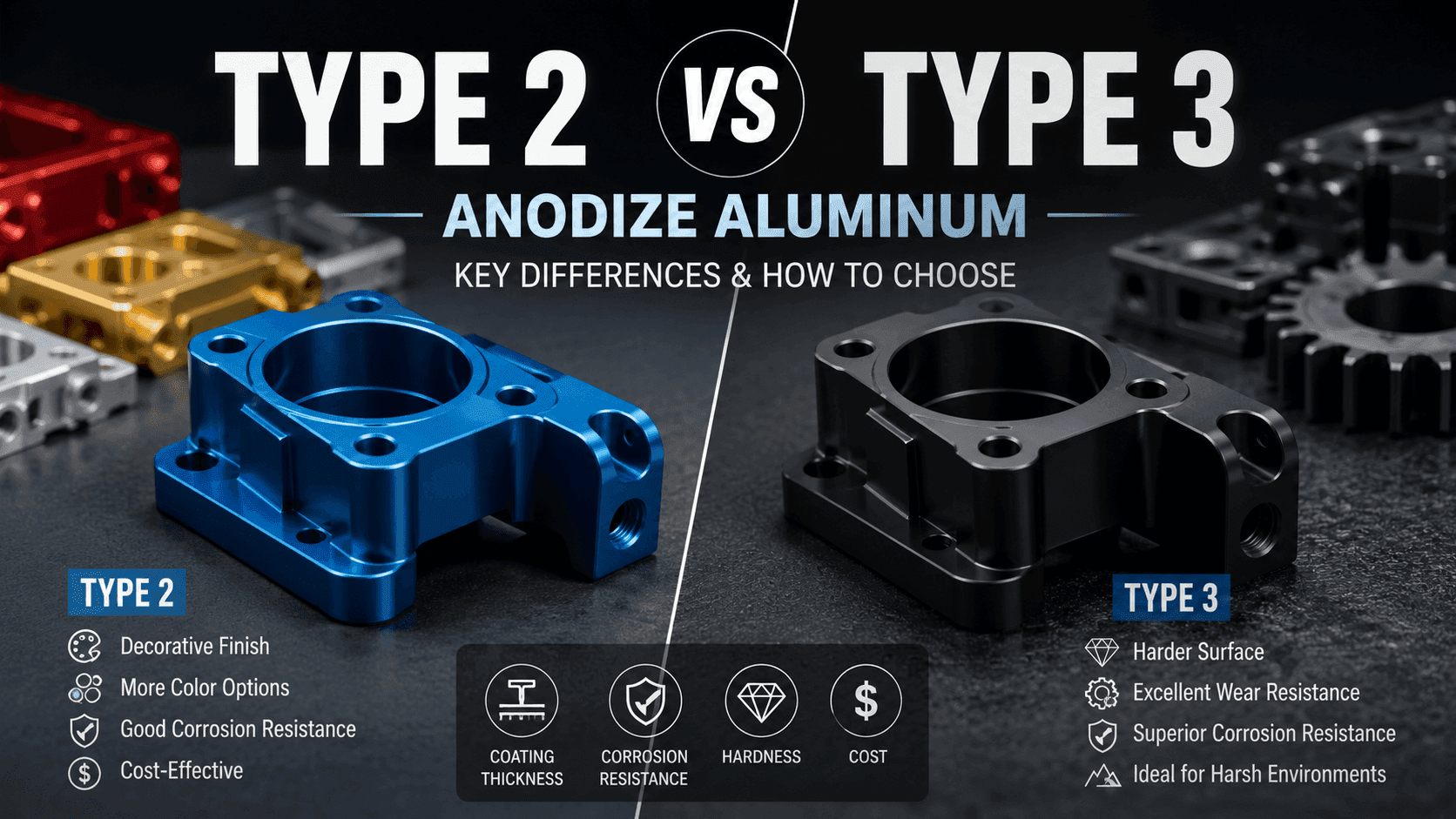
When ordering CNC machined aluminum parts, anodizing is often one of the last decisions to make—but it can have a major impact on the part’s appearance, durability, and cost.
Two of the most common options are Type II and Type III anodizing.
At first glance, the difference seems simple: Type III is thicker and more durable. But in real CNC manufacturing, the right choice depends on how the part will be used, the aluminum alloy, dimensional requirements, surface appearance, and budget.
This guide explains the practical differences between Type II and Type III anodizing so you can choose the right finish for your aluminum CNC parts.
Anodizing is an electrochemical surface treatment used to improve the properties of aluminum.
Unlike paint or powder coating, anodizing does not simply add a layer of material on top of aluminum. It converts the aluminum surface into a controlled oxide layer.
This oxide layer can improve:
For CNC machined aluminum components, anodizing is especially popular because it can provide both functional protection and a clean, professional appearance.
The two most common sulfuric acid anodizing options are Type II and Type III.
| Feature | TypeⅡ Anodizing | TypeⅢ Anodizing |
|---|---|---|
| Common name | Conventional anodizing | Hard anodizing / hardcoat |
| Typical coating thickness | up to around 1mil | Typically up to around 2mil |
| Hardness | Good | Much higher |
| Wear resistance | Good | Excellent |
| Corrosion resistance | Good | Excellent |
| Color options | Wide range | More limited |
| Appearance | Smooth and decorative | Usually darker and more technical |
| Dimensional impact | Relatively low | Higher |
| Cost | Lower | Higher |
| Typical applications | Consumer products, housings, brackets | Industrial components, wear parts, aerospace |
| Best for | Appearance+protection | Durability+wear resistance |
Type II anodizing is the more common choice for aluminum CNC parts where appearance, corrosion protection, and reasonable durability are important. It creates a relatively thin oxide layer and is available in a wide variety of colors. Black, clear, red, blue, gold, and other colors are commonly used for CNC machined aluminum components.
Advantages of Type II Anodizing
Type II anodizing is commonly used for:
If your aluminum CNC part is primarily exposed to normal handling and environmental conditions, Type II is often sufficient.
Type III anodizing is commonly known as hard anodizing or hardcoat anodizing.The main purpose is not decoration. It is to create a significantly thicker and harder oxide layer that can withstand more demanding operating conditions.
Compared with Type II, Type III generally provides better resistance to:
This makes it particularly useful for industrial CNC components that repeatedly contact other parts or operate in harsh environments.
Advantages of Type III Anodizing
This is one of the biggest differences. Type III produces a significantly harder anodized surface than Type II. However, anodizing does not turn aluminum into steel or another hard metal. The underlying aluminum remains relatively lightweight, while the surface receives a harder oxide layer. This distinction matters when designing CNC parts. If your component experiences significant mechanical wear, simply specifying "black anodized aluminum" may not be enough. You should specify the anodizing type and required coating thickness.
For example:
Type II anodizing
Better for appearance and general protection.
Type III hard anodizing
Better for wear resistance and demanding mechanical applications.
Both provide good corrosion resistance, but Type III generally offers better protection because of its thicker oxide layer. That does not mean Type II is unsuitable for outdoor or industrial applications. For many CNC aluminum parts, Type II provides more than enough corrosion resistance. The correct choice depends on the actual environment.
Consider Type III when the component will be exposed to:
For a decorative housing inside a controlled environment, Type II may be the more practical choice.
If color is an important part of your product design, Type II is usually the better choice.
Type II anodizing offers a broader range of color possibilities and is widely used for visible consumer and industrial products.
Type III can also be colored, but achieving bright and consistent colors can be more challenging because the thicker coating and process conditions affect the final appearance.
Hard anodized aluminum often has a darker, more industrial appearance. For example, if you need a bright red or blue CNC aluminum housing, Type II is generally more suitable. If you need a highly wear-resistant black aluminum component, Type III may be the better choice.
Yes.
This is an important consideration that is sometimes overlooked when ordering CNC machined aluminum parts. Anodizing adds an oxide layer to the surface. Therefore, the final dimensions of a precision CNC component can change slightly. The effect becomes more important with Type III hard anodizing, because the coating is thicker. For tight-tolerance components, the CNC machining and anodizing processes should be considered together.
For example, if a hole must maintain a very tight final diameter, simply machining the hole to the nominal dimension and anodizing afterward may not produce the required final result.
A professional CNC manufacturer should review:
This is one reason why choosing a manufacturer that handles both CNC machining and surface finishing can make the process easier.
No.
The aluminum alloy has a major influence on the final anodizing result. Common CNC alloys such as 6061 aluminum generally anodize well and can produce consistent results. Other alloys may behave differently because of their silicon, copper, magnesium, zinc, or other alloying elements.
For example, some high-strength aluminum alloys can produce darker or less uniform anodized surfaces compared with 6061.
Therefore, if appearance is critical, the alloy and anodizing process should be evaluated together. A good CNC supplier should be able to advise you on the combination of: Aluminum alloy + machining process + anodizing type + color + tolerance requirements.
In most cases, Type III anodizing costs more than Type II.
There are several reasons:
However, the surface treatment is only one part of the total CNC manufacturing cost.
The final price can also depend on:
For this reason, choosing Type III simply because it is "better" is not always cost-effective. If the part does not need the additional wear resistance, Type II may be the better engineering choice.
Choose Type II when your priority is:
For many CNC aluminum parts, Type II provides an excellent balance between appearance, protection, and cost.
Choose Type III when your priority is:
It is particularly suitable when the surface itself is part of the component's functional performance.
The best anodizing specification depends on the complete application. Before requesting a quote, it is helpful to provide your CNC supplier with:
The more complete the specification, the easier it is for the manufacturer to provide an accurate quotation and avoid finishing problems later.
There is no universal "best" anodizing process. Type II is usually the better choice for appearance, color, corrosion protection, and cost. Type III is usually the better choice for hardness, wear resistance, and demanding industrial applications. The key is to match the surface treatment to the part's actual function.
At Longwang, we provide CNC machining and surface finishing services for custom aluminum components. Our manufacturing process can cover the part from machining to anodizing, helping customers avoid communication gaps between different suppliers. Whether you need a prototype, a small production run, or high-volume CNC aluminum parts, send us your 3D CAD file or technical drawing. Our engineers can review the material, tolerances, machining requirements, and anodizing specifications and recommend a practical solution before production. Need Type II or Type III anodized CNC aluminum parts? Send us your drawing for a free DFM review and quotation.
Next
The Core Purpose of Powder Coating in Sheet Metal Fabrication
2026-07-20Discover why powder coating is the gold standard for sheet metal enclosures and brackets. Kown how it provides unbeatable rust shielding, flawless edge coverage, and durable textures while cutting long-term project costs.
What Is CNC Machining and How Does It Work for Precision Manufacturing?
2026-08-27Learn what CNC machining is, how CNC milling and turning work, common materials, tolerances, and how to choose a precision CNC machining supplier.

Get in Touch With us
Helping customers grow steadily and achieve win-win development

Your trusted partner for CNC machining, sheet metal fabrication, stamping, and assembly. From prototyping to mass production with strict quality control.
tel:
0769-82763299
Mobile:
+86 18988716988
fax:
0769-82763199
Address:
No.3 Longze Road, Chang'an Town, Dongguan City, Guangdong Province, China,523861


Copyright © 2008-2026 | Dongguan Longwang Hardware Co., Ltd. | All Rights Reserved.


