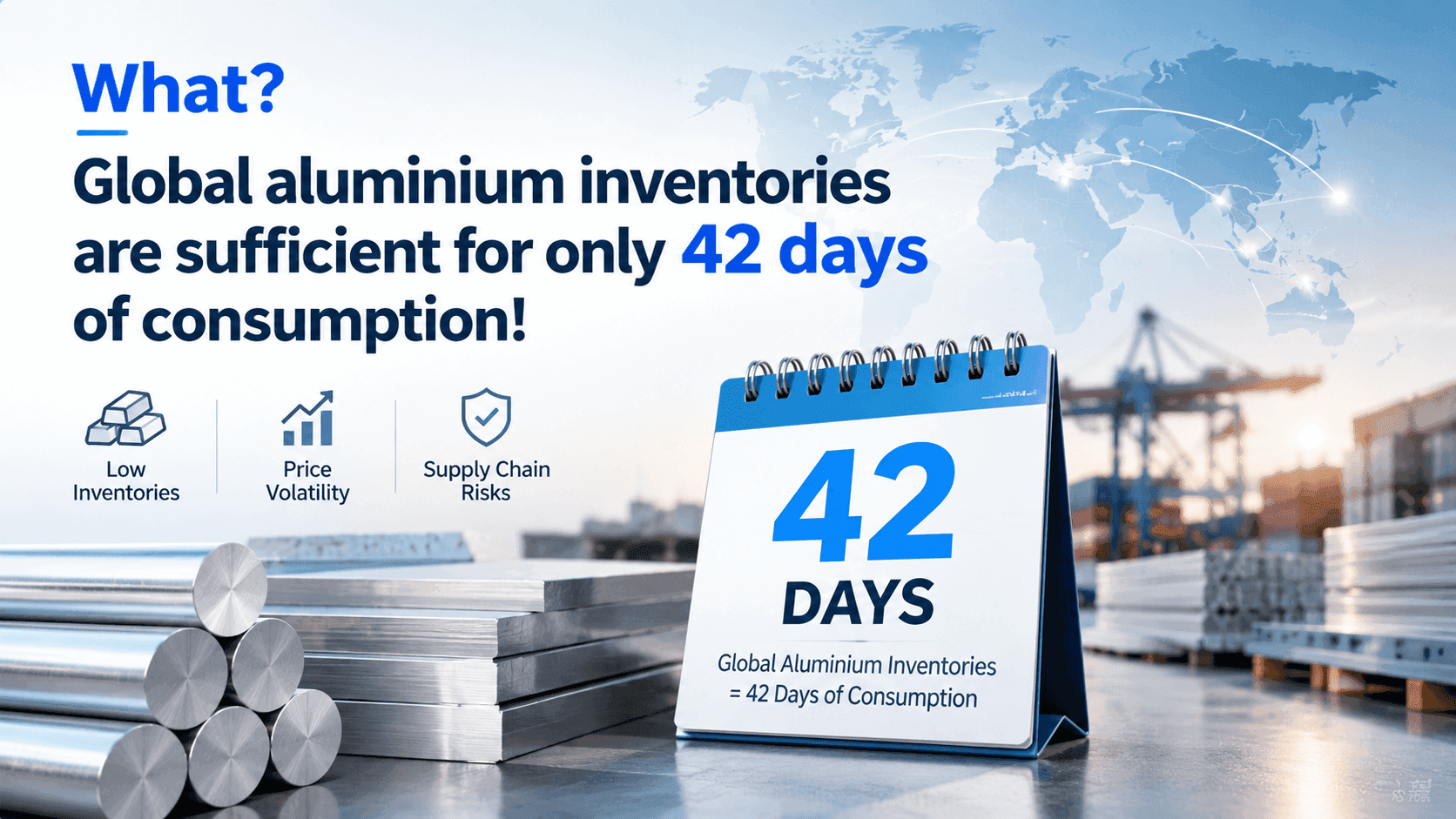
Global aluminum inventories remain exceptionally low, raising concerns about supply security and material costs across the manufacturing industry. On October 16, 2026, Alcoa reported global aluminum inventories equivalent to about 42 days of consumption during its earnings call.
For CNC machining companies, the issue goes beyond commodity prices. Material availability, alloy specifications, procurement lead times, and production planning all influence the final cost of a machined component.
From an engineering perspective, the key question is not simply whether aluminum prices will rise. It is how manufacturers can maintain cost control, product quality, and reliable delivery when material markets become less predictable.
Recent London Metal Exchange (LME) data illustrate why manufacturers should monitor both inventory levels and market prices.
| Indicator | Data | Manufacturing significance |
|---|---|---|
| LME aluminum inventory, Oct. 1, 2026 | 240625 tonnes | Starting reference point |
| LME aluminum inventory, Oct. 15, 2026 | 238125 tonnes | Lower available inventory buffer |
| Inventory change over the period | -2500 tonnes (-1.04%) | Continued inventory decline |
| LME case-settlement price, Oct. 1 | $3120/tonne | Market price reference |
| LME case-settlement price, Oct. 15 | $2999/tonne | Approximately 3.88% lower |
Source: Westmetall LME market data. Percentage changes are calculated from the reported figures.
These figures reveal an important point: low inventories do not automatically mean that aluminium will become more expensive every month. Prices do not guarantee continuously rising aluminium prices. Between October 1 and October 15, both inventory and the LME cash-settlement price declined.
Reuters also reported that disruptions to Gulf aluminium production had removed nearly 3 million tonnes of annualised capacity from the market during the 2026 supply crisis. Production recovery, demand, energy costs, trade policies, transportation, Chinese exports, regional premiums, and expanding Indonesian output helped ease some supply pressures, although physical availability remained tight.
For CNC manufacturers, the practical concern is that these developments mean purchasing decisions should consider actual supplier quotations, alloy availability, and delivery schedules rather than relying on a project, as the required material may become more expensive or harder to obtain, even when aluminium remains available in the broader single market indicator.
Material is one of the main costs widely used in CNC machining. Its impact depends on robotics, agricultural drones, electronics enclosures, and industrial equipment because of its useful strength-to-weight ratio and machinability.
However, material costs vary significantly with part geometry, blank size, production volume, machining time, and material utilization rate.
Consider this illustrative cost calculation:
Example: A 10% increase in raw material cost
| Cost indicator | Before increase | After increase |
|---|---|---|
| Material cost per part | $100 | $110 |
| Material cost for 10,000 parts | $1,000,000 | $1,100,000 |
| Additional material expense | —— | $1000,000 |
Assumption: $100 is the original material cost allocated to each finished part. The example assumes a 10% increase in that cost, unchanged material consumption, and no changes in purchasing terms or scrap recovery. It is not a forecast of aluminum prices.
The actual impact depends on the proportion of material in total manufacturing profit and on how much material contributes to the total part cost. cost.
A simple component with relatively short machining time may be particularly sensitive to material price changes, while a. A complex component requiring extensive machining, milling, multiple setups, and tight-tolerance inspection may have a larger labor and machine-time machining-cost contribution.
Material removal is another important factor when a component is material removal.
A part machined from a solid aluminum billet may require substantial material removal before reaching its final shape. When the starting blank is much heavier than the finished component, raw material costs and machining efficiency deserve particular attention.
Manufacturers should therefore evaluate material costs at the individual part level rather than relying solely on changes in commodity prices.
Low global inventories do not necessarily mean that every aluminum alloy will experience a shortage. However, supply risks can vary significantly by alloy, product form, size, and material condition.
For example:
These materials are not automatically interchangeable. Substituting one for another A substitution may affect strength, corrosion behavior, fatigue mechanical performance, machining characteristics, and surface finishing results behavior, corrosion resistance, and anodized appearance.
Material certification and traceability can also be essential for customer-specific applications. If a supplier cannot deliver the required plate or bar on time, production may be delayed even when alternative aluminum stock is readily available.
To reduce this risk, CNC machining companies should identify critical:
Although manufacturers cannot control the global aluminum market, they can improve the efficiency of their purchasing, processing, and material management.
Choosing the correct Selecting an appropriate blank size is an important starting point. Oversized stock can reduce material consumption and may create unnecessary machining work time. Engineers should review available plate thicknesses, bar diameters, and extrusion profiles, and stock allowances before production begins. The goal is to select a suitable blank without compromising dimensional accuracy or sufficient machining stability allowance.
Design for Manufacturability (DFM) analysis can identify opportunities to simplify machining operations, reduce unnecessary material removal, simplify machining operations, and improve production efficiency process stability.
For aluminum machining parts, engineers should review pocket depths, wall thicknesses, internal corners, rib structures, and machining accessibility. However, material reduction must not compromise stiffness, fatigue life, or functional performance. Thin walls may also increase vibration and distortion during machining, creating additional inspection and rework costs and reducing dimensional stability.
The best design is not necessarily the one that uses the least material. It is the one that achieves the required performance through an efficient and repeatable manufacturing process.
Consider a simplified example in which a component starts as a 1.0kg aluminum blank and finishes at 0.3kg.
| Material utilization indicator | Value |
|---|---|
| Starting blank mass | 1.0kg |
| Finished component mass | 0.3kg |
| Material retained in the finished part | 30% |
| Material removed during machining | 0.7kg |
Potential improvements include optimized nesting, suitable near-net-shape blanks, better stock sizing, and organized recycling of aluminum chips and offcuts.
Purchasing teams should track supplier quotations, actual lead times, inventory availability, and alloy-specific cost changes.
Early procurement or agreed pricing arrangements may reduce exposure to market volatility on long-term projects. However, excessive stock ties up working capital and can create losses if prices subsequently fall.
A balanced strategy should reflect actual demand, consumption patterns, supplier reliability, and the cost of production interruptions.
Low inventories are a reason to monitor the market, but they cannot predict future prices independently.
Several factors can influence the outlook:
The October 2026 market data demonstrate that aluminum prices can decline even while inventories remain low. CNC manufacturers should therefore avoid purchasing decisions based solely on the assumption that prices will continue to increase.
Instead, they should monitor relevant market indicators while using actual supplier quotations and project-specific requirements to guide procurement.
Low global aluminum inventories highlight a supply-chain risk that CNC machining companies should not ignore. The main challenges include material price uncertainty, alloy availability, procurement delays, and pressure on manufacturing margins.
For manufacturers, the most effective response combines disciplined purchasing, accurate cost estimation, improved material utilization, and engineering-led DFM optimization.
For overseas buyers, early material confirmation and transparent supplier communication can reduce avoidable delays and unexpected costs.
At Longwang, we believe reliable precision manufacturing requires more than machining accuracy alone. Careful material selection, process planning, quality control, and coordinated production management all contribute to consistent results.
As aluminum markets evolve, manufacturers that combine engineering expertise with effective supply-chain management will be better positioned to deliver quality metal parts at competitive and sustainable costs.
Need support with your next aluminum CNC machining project? Contact Longwang to discuss material selection, DFM considerations, precision machining, and manufacturing requirements for your custom components.
Next
How Geometry,Tolerances,Material, and Quantity Affect CNC Machining Cost?
2026-10-14CNC machining cost depends on more than the price of raw materials or the hourly rate of a machine. Part geometry, dimensional tolerances, material properties, and order quantity all influence how a component is manufactured, inspected, and delivered.

CNC Machining for Robotics: Materials, Components, and Design Considerations
2026-10-19CNC machining for robotics allows manufacturers to produce custom metal components with controlled dimensions, complex geometries, and functional surface finishes. However, successful production involves more than selecting a machine. Material properties, tolerances, part geometry, and assembly requirements must work together. This guide explains the main CNC machined robot parts, how to select suitable materials, and what engineers should consider when designing components for robotic applications.

Get in Touch With us
Helping customers grow steadily and achieve win-win development

Your trusted partner for CNC machining, sheet metal fabrication, stamping, and assembly. From prototyping to mass production with strict quality control.
tel:
0769-82763299
Mobile:
+86 18988716988
fax:
0769-82763199
Address:
No.3 Longze Road, Chang'an Town, Dongguan City, Guangdong Province, China,523861


Copyright © 2008-2026 | Dongguan Longwang Hardware Co., Ltd. | All Rights Reserved.


