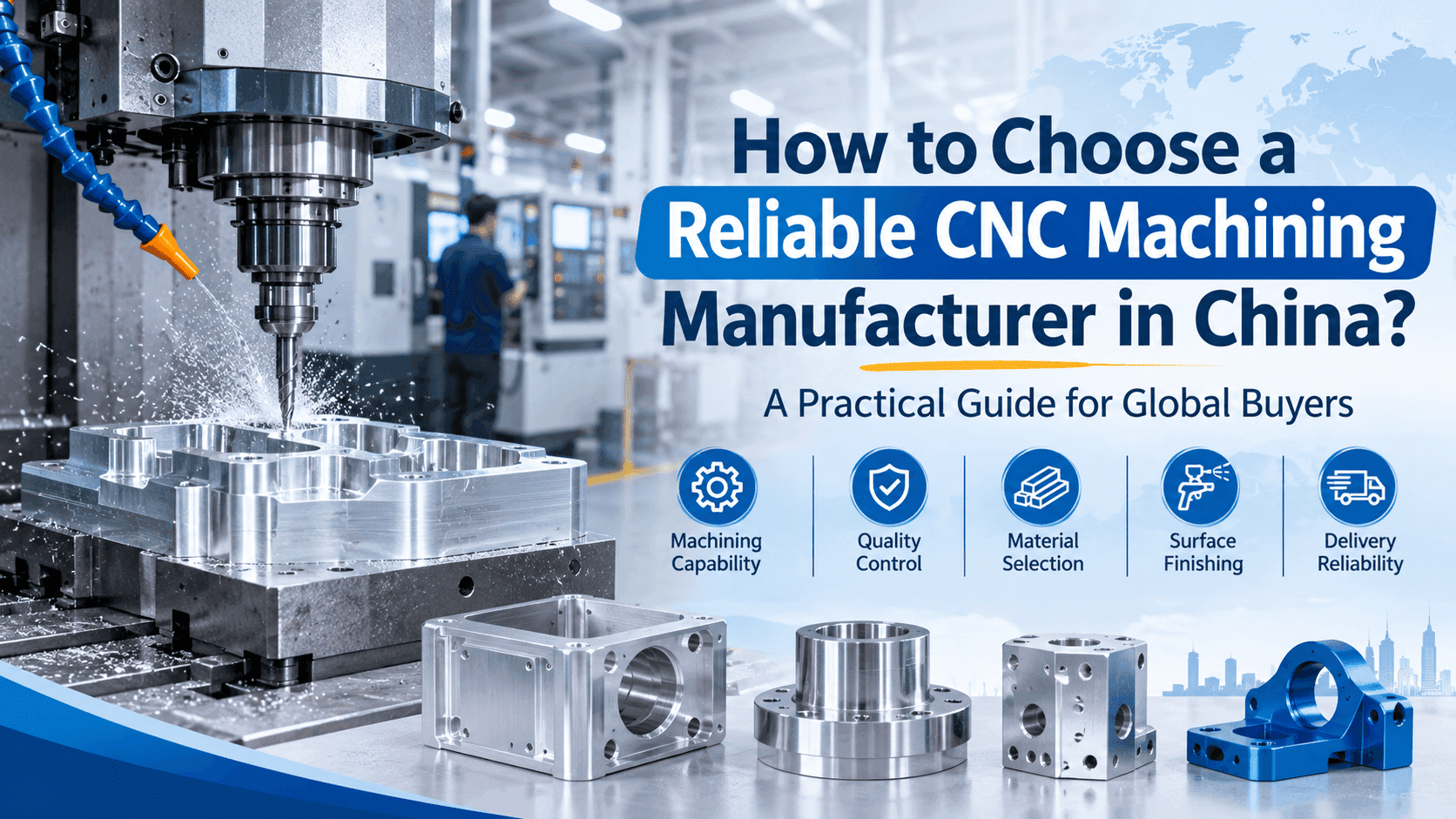
Finding a CNC machining manufacturer in China is relatively easy. Finding one that consistently delivers parts to the required specifications, maintains stable quality, communicates clearly, and meets your production schedule is much more challenging. A competitive quotation does not necessarily mean a supplier is the right manufacturing partner. Differences in machining equipment, engineering support, quality management, material sourcing, and production coordination can have a significant impact on the final cost and reliability of your project. Whether you need a small batch of custom aluminum components or ongoing production of precision mechanical parts, choosing the right supplier requires more than comparing prices.
This guide explains how to evaluate a CNC machining manufacturer in China, what questions to ask during supplier qualification, and which manufacturing capabilities matter most when selecting a long-term partner.
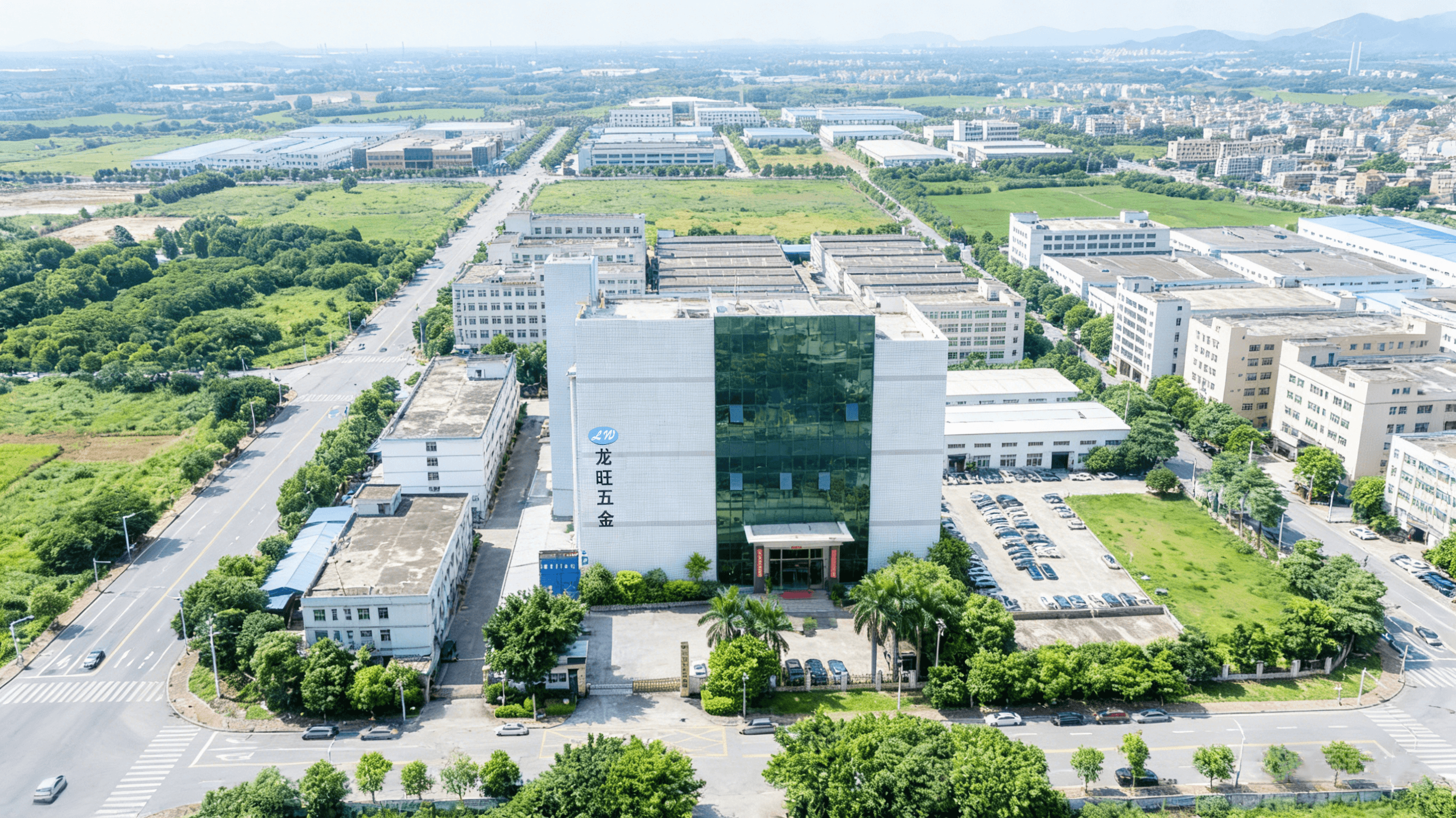
The first step is to determine whether the manufacturer has the equipment, technical knowledge, and production capacity required for your parts. A supplier may advertise CNC machining services without having the right machines or experience for your specific component geometry, material, tolerance, or production volume.
Different parts require different machining strategies. Before requesting a quotation, confirm which processes the manufacturer can perform in-house. Common CNC machining capabilities include:
The important question is not simply how many machines a factory owns. It is whether its equipment is suitable for your part's geometry, tolerances, material, and expected production volume. For example, a complex aluminum housing may require multi-axis machining to reduce repeated setups and improve positional accuracy. A long, slender stainless steel shaft may be better suited to an appropriate turning process with effective workholding and support.
During supplier evaluation, request information about:
A manufacturer should be able to explain how its equipment matches your technical requirements rather than simply sending a general machinery list.
Quality management is one of the most important factors when selecting a CNC machining supplier in China. A part that passes a visual inspection may still have dimensional deviations, incorrect hole positions, poor thread quality, or surface defects. A reliable manufacturer needs a defined inspection process that controls quality throughout production.
Common certifications and quality management systems to consider include:
| ISO9001 | General quality management system |
|---|---|
| ISO14001 | Environmental management system |
| IATF16949 | Automotive industry quality management requirements |
Certifications can provide useful evidence of a manufacturer's management systems, but they do not automatically guarantee that every component will meet your specifications. Always check the certificate's validity, issuing organization, and applicable scope.
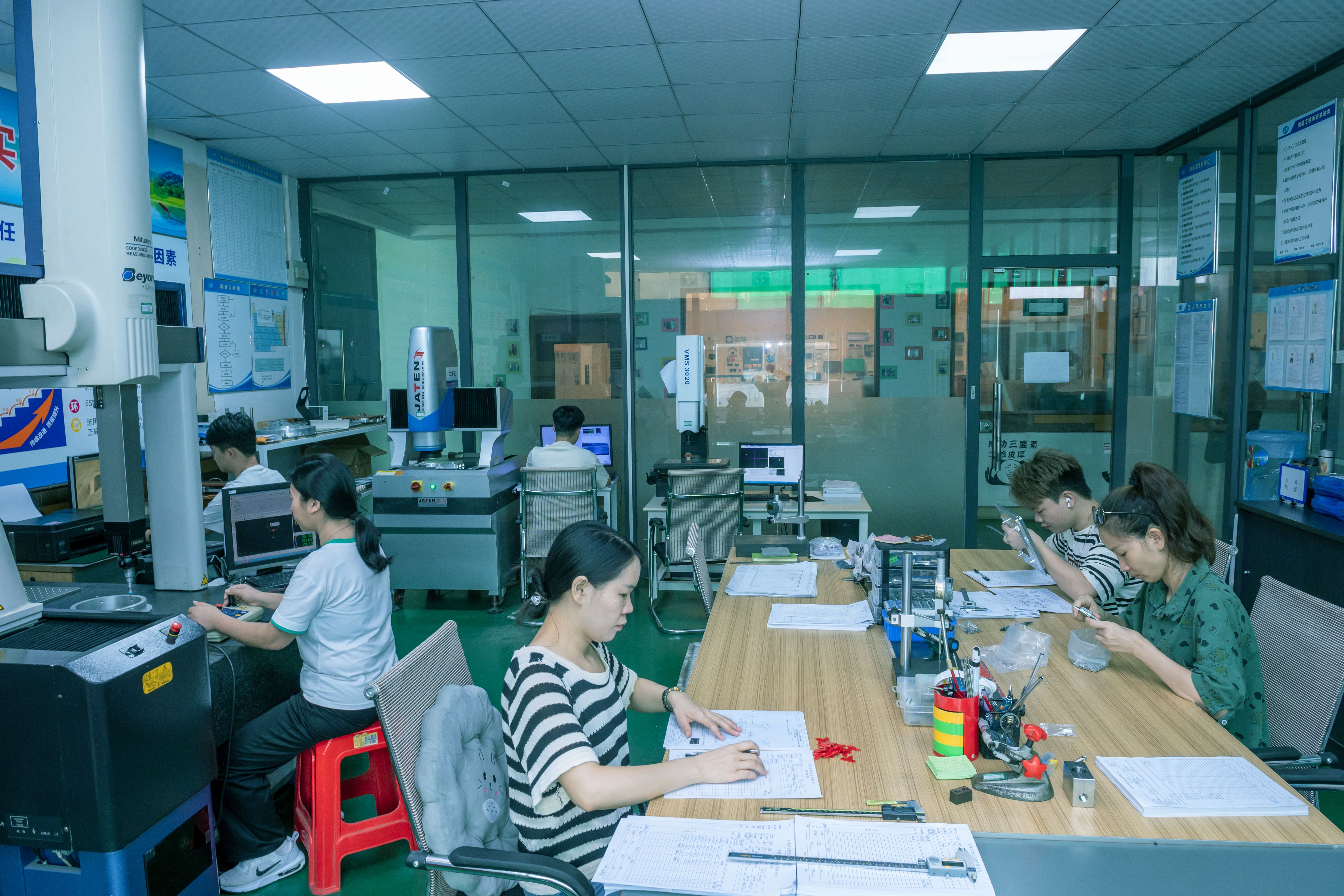
Ask what measurement equipment the supplier uses and whether it is appropriate for your part. Typical inspection equipment includes:
The inspection method should match the drawing requirements. For example, a standard caliper may be sufficient for a general length dimension, but it is not an appropriate substitute for a CMM when verifying complex geometric tolerances.
Understand the Inspection Process
A dependable supplier should be able to explain how inspection is performed at different production stages. A typical quality workflow may include:
Material selection directly affects machinability, mechanical performance, corrosion resistance, weight, and manufacturing cost. An experienced CNC machining manufacturer should be able to help evaluate material options based on the component's operating environment and functional requirements.
| Material | Typical Applications | Key Considerations |
|---|---|---|
| Aluminum Alloy 6061 | Housings, brackets, structural components | Good machinability and strength-to-weight ratio |
| Aluminum Alloy 7075 | High strength mechanical components | High strength, but material cost and corrosion protection need consideration |
| Stainless Steel 304 | General industrial components and fittings | Corrosion resistance and relatively challenging machining |
| Stainless Steel 316 | Marine, medical, and chemical-related components | Improved corrosion resistance in many environments |
| Brass | Connectors, fittings, and precision turned parts | Good machinability and electrical conductivity |
| Carbon Steel | Shafts, mechanical parts, and structural components | Heat treatment and corrosion protection may be required |
| POM | Bushings, guides, and low friction components | Good dimensional stability for many applications |
Do not select a material based on price alone. For example, aluminum alloy 6061 is often a practical option for general-purpose CNC-machined housings. However, if a component requires higher strength, aluminum alloy 7075 may be worth evaluating. The final choice should consider load, environment, surface treatment, machining complexity, and total project cost.
For projects with strict requirements, confirm whether the manufacturer can provide:
Material traceability is particularly important when parts are used in automotive, aerospace, medical, or other applications with specific documentation requirements.
Machining is only one part of the manufacturing process. Many CNC machined components require additional surface finishing to achieve the required appearance, corrosion resistance, wear resistance, or functional performance. If a manufacturer cannot manage these processes effectively, you may need to coordinate multiple suppliers. This can increase communication costs, transportation time, and the risk of quality inconsistencies.
| Surface Treatment | Typical Benefits | Common Applications |
|---|---|---|
| Anodizing | Improved corrosion resistance and surface appearance on aluminum | Aluminum housings, brackets, and most aluminum parts |
| Hard Anodizing | Increased surface hardness and wear resistance | Mechanical and industrial components |
| Sandblasting | Uniform matte texture and surface preparation | Aluminum enclosures and visible parts |
| Power Coating | Decorative and protective coating | Sheet metal enclosures and equipment housings |
| Electroless Nickel Plating | Uniform nickel coating and improved surface properties | Precision mechanical components |
| Passivation | Helps improve stainless steel corrosion resistance | Stainless steel parts |
| Polishing | Improved surface appearance and smoothness | Decorative and functional parts |
Surface finishing can affect more than appearance. For example, anodizing adds a coating layer that can influence final dimensions. If a component has tight-fit holes, threaded features, or precision mating surfaces, these areas may require masking or specific dimensional allowances. A capable manufacturing partner should consider surface finishing during the engineering and machining stages, rather than treating it as an isolated operation after production.
For many overseas buyers, the biggest challenge is not finding a factory that can machine one component. It is finding a supplier that can coordinate multiple manufacturing processes and deliver a complete assembly or finished product. If your project includes CNC machining, sheet metal fabrication, surface treatment, purchased components, and final assembly, working with several independent suppliers can create additional coordination challenges. Consider a One-Stop Manufacturing Partner, a manufacturer with integrated capabilities that may support several stages of your project:
| Manufacturing Stage | Relevant Capabilities |
|---|---|
| Design and Engineering | Drawing review, DFM feedback, manufacturing recommendations |
| CNC Machining | 3-axis, 4-axis, 5-axis milling and CNC turning |
| Sheet Metal Fabrication | Laser cutting, bending, stamping, and welding |
| Surface Finishing | Anodizing, sandblasting, powder coating, and other finishing processes |
| Component Sourcing | Coordination of purchased parts and external suppliers |
| Assebmly | Component integration and assembly support |
| Quality Control | Dimensional inspection, process checks, and final verification |
| Delivery | Packaging, shipment coordination, and export support |
This model can reduce the number of suppliers you need to manage and make it easier to coordinate production schedules and quality requirements. However, one-stop manufacturing does not automatically mean every process happens in one facility. Ask the supplier which processes are handled in-house, which are outsourced, and how external suppliers are qualified and monitored.
A competitive price is not valuable if the supplier cannot deliver the parts when your production line needs them. When evaluating a CNC machining manufacturer in China, look at the full order process, not just the estimated machining time. Lead time depends on material availability, part complexity, machining hours, finishing requirements, inspection workload, and production capacity. Ask for a realistic project schedule based on your actual drawings and quantities.
Evaluate Communication Quality
Reliable communication is especially important when working across time zones. A good supplier should be able to:
During the quotation stage, pay attention to how the supplier handles technical questions. If important details are misunderstood before an order is placed, the same problems may become more costly during production.
Choosing a manufacturing partner is a long-term business decision. Buyers need more than machining equipment: they need engineering support, consistent quality management, coordinated production, and dependable delivery.
Dongguan Longwang Hardware Co., Ltd. is a manufacturing solutions provider based in Dongguan, Guangdong, China. Established in 2008, LongWang supports customers with CNC machining, sheet metal fabrication, surface finishing, and assembly-related manufacturing services.
Integrated Manufacturing Capabilities
Longwang's manufacturing capabilities cover multiple processes, helping customers coordinate different components and production requirements through one manufacturing partner.
Key capabilities include:
Manufacturing Resources and Quality Systems
Longwang's stated manufacturing resources include a facility of nearly 30,000 m², more than 500 employees, and over 700 machines. The company operates under quality and management systems associated with ISO 9001, ISO 14001, and IATF 16949 certifications. These resources support a range of custom manufacturing requirements, from individual precision components to projects involving multiple processes.
From Component Machining to Integrated Manufacturing
Longwang works with customers across applications such as electronic equipment, industrial machinery, automotive components, agricultural drone parts, and custom mechanical products. For projects involving multiple manufacturing processes, customers can discuss machining, sheet metal fabrication, surface treatment, component sourcing, and assembly requirements together. This approach helps simplify supplier coordination and supports a more connected manufacturing workflow from engineering review to finished-product delivery.
Looking for a Reliable CNC Machining Partner in China?
Whether you need custom CNC machined parts, sheet metal components, surface finishing, or integrated assembly services, LongWang can help evaluate your manufacturing requirements.
Send us your 2D drawings or 3D CAD files, together with your material, quantity, and finishing requirements. Our team can review your project and provide manufacturing feedback and a quotation.
Contact Longwang to discuss your next manufacturing project.
Next
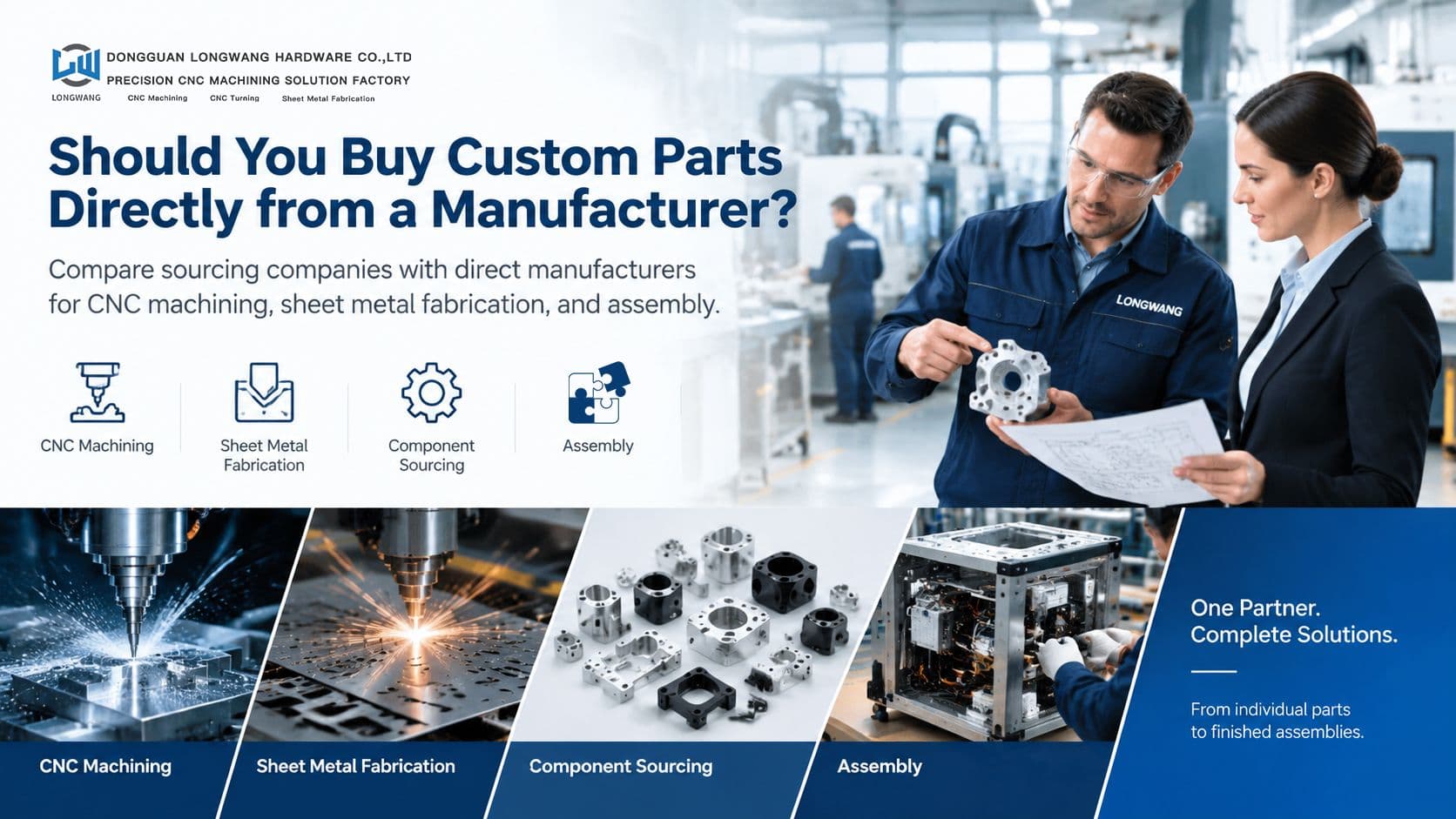
Should You Buy Custom Parts Directly from a Manufacturer or Through a Sourcing Company?
2026-10-30When sourcing custom CNC machined parts, sheet metal components, or assembled products, manufacturers have two common options: work directly with a factory or purchase through a sourcing company. Both approaches can work well, but the right choice depends on product complexity, supplier management resources, quality requirements, and total procurement cost.
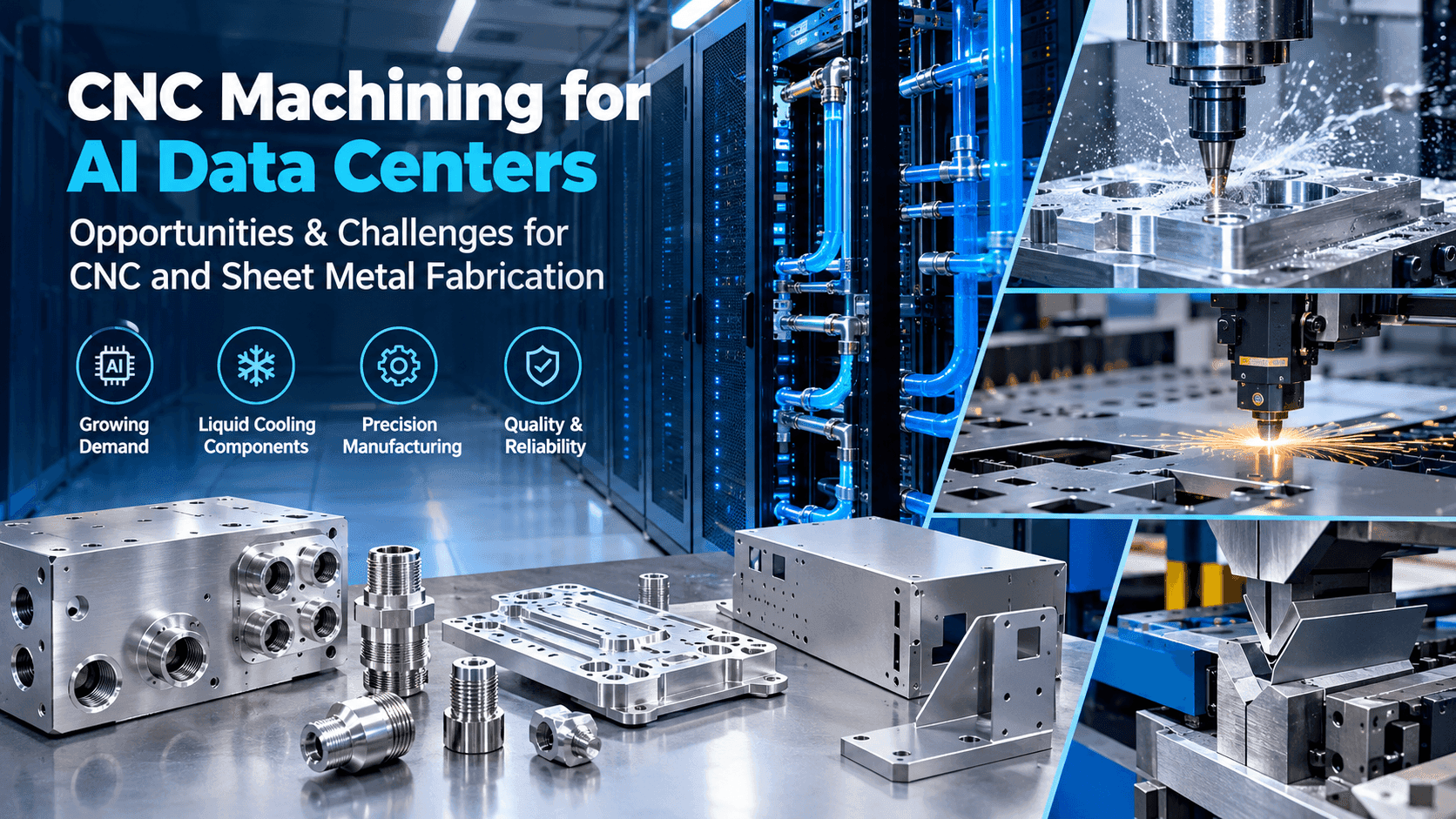
How Can CNC Machining and Sheet Metal Fabrication Companies Benefit from the AI Boom?
2026-10-27For CNC machining and sheet metal fabrication companies, this creates new opportunities beyond traditional industrial markets. As AI infrastructure expands, manufacturers may find demand for liquid cooling components, precision fittings, structural brackets, equipment enclosures, server chassis, and custom metal parts.

Get in Touch With us
Helping customers grow steadily and achieve win-win development

Your trusted partner for CNC machining, sheet metal fabrication, stamping, and assembly. From prototyping to mass production with strict quality control.
tel:
0769-82763299
Mobile:
+86 18988716988
fax:
0769-82763199
Address:
No.3 Longze Road, Chang'an Town, Dongguan City, Guangdong Province, China,523861


Copyright © 2008-2026 | Dongguan Longwang Hardware Co., Ltd. | All Rights Reserved.


