Surface Roughness: The Silent Force Shaping Your CNC Machined Parts
Ever wondered why two CNC machined parts, looking identical to the naked eye, perform drastically differently? The answer often lies hidden in the microscopic peaks and valleys of their surfaces – a characteristic defined by surface roughness. At Dongguan Longwang Hardware Co., Ltd., precision isn't just a goal; it's embedded in every surface we create. Understanding surface roughness is fundamental to achieving the functionality, longevity, and aesthetics your parts demand.
What Exactly is Surface Roughness?
Surface Roughness, often simply called roughness, quantifies the microscopic deviations from an ideal, perfectly flat surface on a machined component. Imagine zooming in incredibly close on a seemingly smooth metal surface – you'd see a landscape of peaks (the highest points) and valleys (the lowest points). Surface roughness measures the “height and spacing” of these minute irregularities left behind by the machining process (turning, milling, grinding, etc.).
It's distinct from waviness (larger, more spaced-out deviations often due to machine vibration or deflection) and "form" (the overall macroscopic shape of the part). Roughness is about the fine texture imparted by the cutting tool's action and the machining parameters.
Why Should You Care? It's More Than Just Looks!
Surface roughness profoundly impacts the performance and cost of your components:
1. Friction & Wear: A rougher surface creates more friction between moving parts, accelerating wear and reducing lifespan. Smoother surfaces are essential for bearings, gears, and sliding components.
2. Fatigue Strength: Rough surfaces act as stress concentrators. Tiny valleys can be the starting point for fatigue cracks under cyclic loading, potentially leading to catastrophic failure. Smoother surfaces enhance fatigue resistance.
3. Sealing Ability: Effective seals (gaskets, O-rings) require a specific surface texture. Too rough, and leaks occur; too smooth, and the seal might not have enough "bite" or lubricant retention.
4. Corrosion Resistance: Rough surfaces have more surface area and can trap corrosive agents, making the part more susceptible to rust and degradation. Smoother finishes often offer better corrosion protection.
5. Coating Adhesion: Paint, plating, and anodizing adhere much more effectively and uniformly to surfaces with optimal roughness. An improper finish can lead to peeling or bubbling.
6. Aesthetics & Perception: While functional aspects are primary, the visual appearance and tactile feel of a surface influence perceived quality. Specific roughness levels are chosen for cosmetic appeal.
7. Lubrication: The right surface texture helps retain lubricating oil films, crucial for hydrodynamic lubrication in engines and transmissions.
Measuring the Micro: Key Parameters & Tools
How do we quantify these tiny imperfections? Several parameters exist, but the most common is “Arithmetic Average Roughness (Ra)”.
l Ra (Average Roughness):This is the absolute average of the vertical deviations (peaks and valleys) from the mean line over a defined sampling length. Think of it as the "average height" of the surface irregularities.
n Example: An Ra 1.6 µm surface is smoother than an Ra 3.2 µm surface.
l Rz (Average Maximum Height):Measures the average difference between the five highest peaks and the five deepest valleys within the sampling length. It gives a sense of the maximum profile extremes.
l Rt (Total Roughness Height): Represents the absolute vertical distance between the single highest peak and the single deepest valley over the entire evaluation length.
Measuring Tools:
l Surface Roughness Testers (Profilometers): The industry standard. A fine stylus physically traces the surface, precisely recording its vertical movements. Data is processed to calculate Ra, Rz, Rt, and other parameters. (Image Idea: Close-up photo of a stylus profilometer measuring a CNC-machined part surface).
l Optical Profilometers: Use non-contact techniques like light interference or confocal microscopy to create 3D surface maps. Ideal for very delicate surfaces.
l Comparison Specimens: Physical samples with known roughness values. Used for a quick visual and tactile comparison in workshops, though less precise than electronic measurement.
The Language of Roughness: Understanding Symbols on Drawings
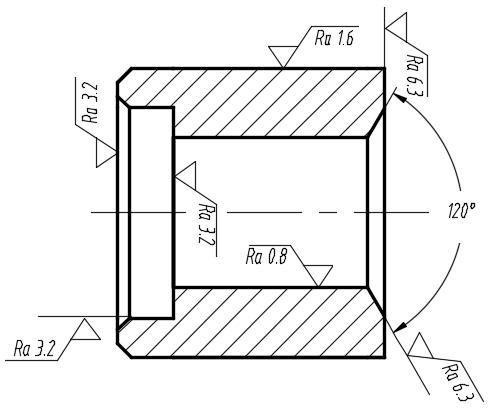
Engineers specify required surface roughness on technical drawings using standardized symbols:
l The Checkmark Symbol (√): The basic symbol indicating a surface finish requirement.
l Roughness Value (e.g., Ra 3.2): Placed next to the symbol, stating the parameter and its maximum allowable value (sometimes min/max).
l Machining Allowance: If specified, indicates how much material should be left for finishing.
l Production Method: Sometimes specified (e.g., "Milled," "Ground").
l Sampling Length/Lay Pattern: Can be added for critical applications.
Mastering the Finish: Controlling Roughness in CNC Machining
Achieving the precise roughness specified isn't magic; it's the result of expertly controlling machining parameters:
1. Cutting Tool Selection & Condition:
a) Tool Material & Geometry: Sharp tools with appropriate rake and clearance angles produce smoother finishes. Coated carbide often outperforms HSS. Round inserts generally yield smoother finishes than sharp corners.
b) Tool Wear: A dull or chipped tool *dramatically* increases roughness. Consistent tool inspection and replacement are critical.
c) Tool Deflection: Minimizing vibration and chatter is essential. Rigid setups and appropriate tool lengths help.
2. Cutting Parameters:
a) Feed Rate: The single most influential factor. A lower feed rate significantly reduces the height of the theoretical "cusp marks" left by the tool, resulting in a smoother surface (lower Ra). However, slower feeds increase machining time/cost.
b) Cutting Speed (Vc): Higher speeds often allow for better finishes (within the optimal range for the material/tool), but excessive speed can cause tool wear or vibration, increasing roughness.
c) Depth of Cut: Lighter finishing passes are used specifically to achieve the final smooth surface after heavier roughing cuts.
3. Workpiece Material: Ductile materials like aluminum can sometimes be challenging to get a very smooth finish on without built-up edge. Harder materials often grind or finish more readily to low Ra values. Material consistency matters.
4. Machine Tool Rigidity & Condition: A worn-out spindle or loose guideways induces vibration, directly translating into poor surface finish. High-precision, well-maintained CNC machines are essential for consistent low Ra values.
5. Coolant/Lubrication: Effective cooling reduces thermal distortion and tool wear. Lubrication minimizes friction and built-up edge formation, both contributing to a better finish.
6. Fixturing: Secure, vibration-free clamping prevents part movement during machining, which degrades surface quality.
7. Post-Processing: For ultra-smooth finishes (very low Ra), secondary operations like grinding, honing, polishing, or lapping are often necessary after initial CNC machining.
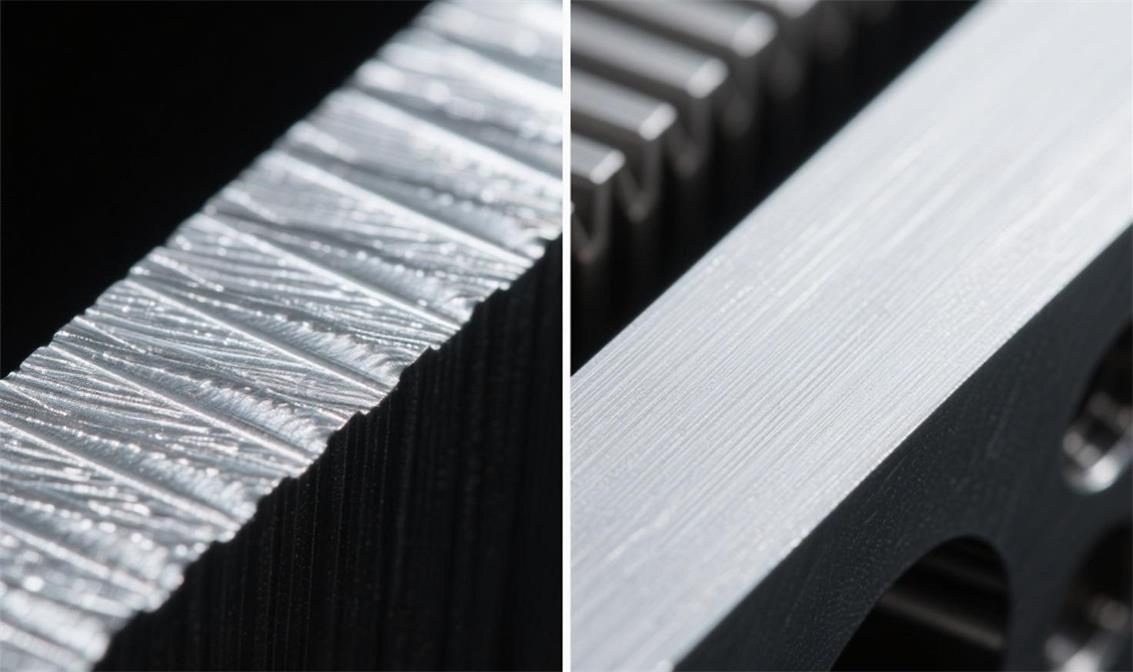
Beyond Ra: Optimizing for Function at Longwang Hardware
At Longwang Hardware, we don't just hit a number; we understand the why. Specifying "as smooth as possible" is rarely ideal or cost-effective. We collaborate with you to determine the optimal roughness based on the part's function:
l Is it a sealing surface? (Requires specific texture for seal bite/lubrication retention)
l Is it a bearing journal? (Needs low Ra for low friction/high wear resistance)
l Is it a structural component under cyclic load? (Requires low Ra to minimize stress risers)
l Is it an aesthetic surface? (Requires visually pleasing, consistent finish)
Our Expertise, Your Precision Advantage
Leveraging advanced CNC machining centers, stringent process controls, and expert machinists, Longwang Hardware consistently delivers parts that meet precise surface roughness specifications, ensuring performance, durability, and value. We utilize precise measurement equipment to verify every critical dimension, including surface finish.
Ready to harness the power of precision surface finishes for your next project?
Contact Dongguan Longwang Hardware Co., Ltd. today!
Let our expertise in CNC machining and surface control elevate the quality and reliability of your components.